
Baseball Is Starting, And Everything Is Just Right!


Oh man, you guys – I’m excited. Like, super duper excited.
That doesn’t sound very manly, does it? “Super duper excited”? Let’s try this: I’m freaking pumped! Baseball is back!
This is the second intro I have written for this article… even though I already spent a chunk of hours writing the first intro (the one you’re not reading at the moment, because I decided to write this intro instead). The guys at RotoGrinders are going to be annoyed with me, because this is the first article of the season. I had plenty of time, right? I could have gotten this article to them several days ago. But I didn’t. I wrote the intro (uh…the original intro – the one I’m no longer using in this article) earlier in the week, but then some pressing projects came up with my freelance writing work, so I pushed the completion of this article back a couple days. Then, the weather was perfect, so I went camping for a couple days. Then, I planned to return home from camping early in the afternoon on Saturday, and I was going to finish this article and at least get it to the good folks at RG by Saturday evening so they could look over everything before posting it. But instead, I decided to write an entirely new intro, and I’m now getting this to them early Sunday morning. (Sorry, guys!)
It’s not even that the original intro was no good. It was really good, honestly. Maybe I’ll use it next week. We’ll see. It was simply that the original intro was not just right for this first article. I wanted it to be just right. After all, when it comes to DFS, you want everything to be just right!
Oh, what’s that? Some of you don’t know me, huh? Some of you started playing DFS during NBA and are just now making the switch to MLB? Others of you have been playing DFS for a while, but you just started visiting RG recently? (What the heck is wrong with you!)
For those of you who don’t know me from my NFL articles:
“Hi. My name is JM Tohline (pronounced Tuh-lean, if you care to get it right). Actually, you can call me Jordan if you want – that’s what most of my friends call me. JM is the name I use for my writing. But whatever you call me, I’m me: JM (Jordan) Tohline – JMToWin on DFS sites. And you are? (Seriously – let me know! Introduce yourself in the comments. After all, if we are going to be on this journey together throughout the season, we may as well be pals!)”
Throughout this season, I will be writing three articles each week for RotoGrinders. Each Tuesday and Friday, you will be able to find a traditional DFS article from me, with an intro that balances good writing with entertainment with quality thoughts regarding DFS strategy, followed by content that breaks down that day’s slate of games.
Each Sunday, I’ll be doing something a little different – something that is particularly unique in the realm of a truly daily sport such as MLB: Instead of breaking down that day’s slate of games, I’ll be taking a look at some of the trends we have been seeing over the previous week, and I’ll be looking ahead toward some of the ways in which you can take advantage of these trends during the week to come. I’m super duper excited (crap! – I mean, “I’m freaking pumped”) about the Sunday article I’ll be doing this year. And – hey, would you look at that! – today is Sunday. So, today is the first of these articles! Today, everything is just right.
My original intro for this article dove into some DFS thoughts that are, in my opinion, very important for every DFS player to understand in order for them to reach an optimal level of success. What that intro failed to do, however, was introduce to you some of the core ideas behind my approach to MLB. Because it will be beneficial for you to understand my approach in order to get the most out of my content, I am going to take the opportunity this (second) intro provides to dive into the way I see MLB DFS.
Oh, what’s that? You want to know if it’s actually worth paying attention to my thoughts on this topic?
I guess, ultimately, the best response to that is: check out my articles each week, apply the thoughts I present, and decide for yourself if it is worth it. I will, however, let you know that I managed to grab a pair of seats last year to the DraftStreet $1 million tourney (RIP), and I won an additional seat to DraftKings’ million dollar tourney in Atlantis (where I finished 7th place). I also made more money last year in MLB DFS than I made in my regular freelance work (and I do alright for myself in my freelance work!), so I have a pretty good handle on the ins and outs of this finest of all DFS sports.
With that said, it’s also worth noting that there are many successful MLB DFSers (sure, that’s a real term) who take different approaches from one another. My approach works for me. If you choose to apply my approach, it will work for you! But that is not to say that my approach is the only approach worth using – and it is certainly not to say that my approach is infallible! (My approach may be just right, but as any of you who have played MLB DFS in the past can attest to: nothing is infallible when it comes to – as Ted Williams would have said – assessing how a hitter will do when trying to take a round bat and hit a round ball squarely.)
Because of just how unpredictable hitting can be, MLB is perhaps the least predictable of all DFS sports. This is not the same as saying that MLB is the most difficult, though! As Jonathan Bales would tell you (wait, what? – you haven’t read Bales’ books? – holy Moses, you’re doing DFS wrong!), the great thing about the unpredictability of baseball is that we can use it to our advantage!
As we make our way through the season, we will continually explore that idea. We will go far beneath the surface of that idea, and we will make sure you fully understand it (and that you fully know how to apply it in your own roster construction).
While that is certainly an important means to gaining an edge in MLB, however, there is another MLB truth that is just as important (or, if we’re talking about cash games, is even more important!). That truth?
Pitching is Extremely Predictable
Now, if you’re coming off NBA, I should point out that your concept of “predictable” is currently skewed by just how predictable NBA performances can be. No, pitching is not as predictable as NBA. But when you take the level of predictability from pitchers and compare it to the level of predictability from hitters, the difference is astonishing.
Mike Trout might enter a day as the highest-priced hitter on the board and go 0-4 with two strikeouts. It happens. (How often does it happen? Last year, Trout played in 157 games. In 47 of those games – thirty freaking percent – he came away with zero hits.)
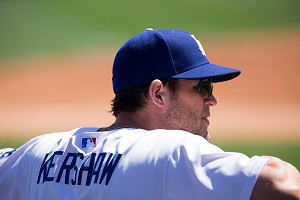
But how likely is it that Clayton Kershaw will step on the mound and fail to rack up strikeouts, and only last five innings, and give up a bunch of runs? Try this: in 27 starts last year, Kershaw failed to reach six innings only three times. In one of those, he notched 9 strikeouts in 5 innings…and got a complete game victory when weather shortened the game. In another, it took him 106 pitches to get through 5 innings, but he still notched 9 strikeouts. In the third instance, he actually had a bad game: an inning and two-thirds, with seven runs allowed and only three strikeouts. So really, that’s one bad game – all year.
On the other side of the spectrum (still looking at pitchers), let’s take Colby Lewis. He started 29 games last year for Texas. How many times did he make it into the 7th inning? A mere seven times! In how many starts did he give up zero runs? Two. In how many starts did he give up four or more runs? 13!
The reason I bring up an example on both sides of the pitching spectrum is this: The predictability of pitching should not only be used to help you pick your pitchers! The predictability of pitching should also be used to help you select your hitters.
In sticking with Colby Lewis: The Rangers also had one of the worst bullpens in baseball last year. With Lewis, then, you could stack a team of hitters against him, knowing those guys would have a good shot at picking up several hits, picking up several runs, and getting to a poor bullpen early, where they could turn it on even more!
To summarize, then: the absolute foundation of my MLB DFS approach is centered around predicting pitchers, leaning on the idea that a great pitcher can shut down even a great lineup, while a poor pitcher can often make even a poor lineup look great!
Read that again if you need to. In fact, I’ll write it again in case you need to read it again; it’s truly that important that you grasp this concept:
A great pitcher can shut down even a great lineup, while a poor pitcher can often make even a poor lineup look great!
There are a lot of strategical components that play off this idea, and there are plenty of distinctions between the ways in which this idea is applied to tournaments (where you want to finish at the top of the field) and cash games (where you just need to beat, say, half the field to double your money). But first things first: you need to understand that idea.
Each week, in this article, I am going to highlight some of the areas where you will be able to gain an edge on your competition – both in cash games and in tournaments – and pitching will be one of the main areas we are looking at in order to reach our conclusions. The presentation of our weekly findings will surely look different from week to week – and each week, I will also dig into some of the strategy concepts around the information I am sharing – but understanding that idea of just how important “predicting pitching” is to “MLB DFS success” will put you in position to take a just right approach to your MLB roster construction.
Because this week is a bit unique (because the first couple weeks of the season are a bit unique, honestly), to where we are not even dealing with “small sample sizes,” but are instead dealing with NO sample sizes, we find ourselves in the interesting position of relying more on “projections” than on “current data.” The more we collect “current data,” however, and start to see how teams are performing compared to their original expectations, the more we will be able to see areas where we can take advantage of the trends that are occurring and can create an edge as a result.
Finding an Edge in Week One
“But…wait, can we still create an edge this first week?”
Absolutely!
Below, you will find some areas where you can capitalize on both hitters and pitchers during this first week of what is sure to be a glorious MLB season!
HITTERS:
There are plenty of injuries already as we head into the season, and these injuries will open opportunities for low-priced backups to step into prominent roles in the lineups. Because baseball is such a day-to-day sport, it would be a waste of my time and yours for me to attempt to predict exactly who will fill in for each injured player, and exactly where in the lineup these players will be hitting (as we move deeper into the season, it will become far easier to project such things several days in advance; for now, however, doing so would be basically a coin flip!). And so, below is the list of important hitters who are starting the season injured. Each day this week, you should be checking starting lineups to see who is starting in place of these players, and where in the batting order these backups are hitting (if they are in the top six in the order – and especially if they are in the top four or five – they gain a huge boost, at a severely reduced price!). Know these injuries, and take advantage of them this week!

Catcher:
Matt Wieters, Orioles – Out at least this first week
2nd Base:
Nick Franklin, Rays – Franklin is likely to miss this week, but check lineups to make sure
Maicer Izturis, Jays – Should miss the first week or so of the season
Shortstop:
J.J. Hardy, Orioles – Should be out the entire first week
Entire Yankees depth chart – Didi Gregorius may or may not be able to play on Opening Day, but Brendan Ryan and Jose Pirela are out; if Didi is out as well, we should see Petit filling in
Chris Taylor, Mariners – Brad Miller will fill in at shortstop the first couple weeks of the season, although these two guys may end up splitting time again anyway
3rd Base:
Anthony Rendon, Nationals – Rendon is expected to miss the first few weeks of the season; he is an important part of the Nationals batting order, so keep an eye out for how they choose to replace him, and where that replacement hits in the lineup
Outfield:
Josh Hamilton, Angels – Is out for a month or so; keep an eye on C.J. Cron – he becomes a great value anytime he’s starting, until his price jumps up
Coco Crisp, A’s – Crisp is out the first month or two
Josh Reddick, A’s – Reddick is out the first couple weeks; there will be a lot of value available in Oakland to start the year
Michael Saunders, Jays – Saunders should miss the first couple weeks of the season
Melvin Upton, Braves – Upton will miss the first couple weeks of the season, and Eric Young Jr. should fill in
Domonic Brown, Phillies – Brown will start the season on the DL
Hunter Pence, Giants – Pence is out until sometime in May
Jayson Werth, Nationals – Werth should miss at least part of (if not all of) the first week of the season; as with Rendon, he’s a big part of this lineup, so keep an eye out to see who gets a boost as a result
Denard Span, Nationals – Man, the Nats are hurting! – Span should be back near the end of April
Designated Hitter:
Nick Swisher, Indians – Is likely to miss the first week of the season
PITCHERS:
Because the season is just starting, and we are therefore left with no trends to look at or stats to analyze, I don’t want to go too far in providing pitching information here. Honestly, I probably did about three hours of research for this section that I am now throwing out because it simply was not useful/valuable enough. Your best bet for picking pitchers, in Week 1, is to read RotoGrinders each day and see who guys like Notorious, myself, and others are suggesting for that specific day.
I will, however, provide you with the list of all the starting pitchers I found who the ZIPS projection system projects to notch more than a strikeout per inning this year. Using season-long projection systems (and cutting down the projections to a game-by-game basis) can be extremely valuable early in the season. Although predicting game-by-game performance is more difficult in MLB than it is in other sports, predicting season-long results is actually far easier in MLB than it is in other sports! Because of this, leaning on season-long projections (and recognizing that you will be consistently profitable over the long run if you are making consistently positive decisions) is a great way to move toward MLB DFS success – especially early in the season!
Here is the list of guys expected to be high on the strikeout list. Notice, as you build your teams this week, that many of these guys are underpriced relative to the strikeout performance expected!
10.37 k/9 – Max Scherzer, Nationals – Scherzer will benefit greatly from the move to the NL
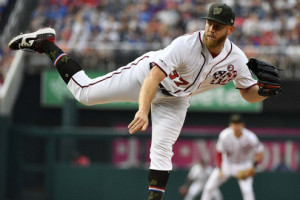
10.12 k/9 – Stephen Strasburg, Nationals – Strasburg is also, however, projected at about 6.23 innings per outing, whereas most of these other guys are projected around 6.7 to 6.8; just something to keep in mind
10.10 k/9 – Clayton Kershaw, Dodgers – Kershaw is the most expensive pitcher, but for good reason; when he plays the Padres this week, however, make sure you keep in mind that this is not last year’s Padres lineup; that’s not to say Kershaw will struggle (it is highly unlikely he will), but he’s not as much of an automatic slam dunk as “Kershaw vs. the Padres” seems to be at first glance
9.87 k/9 – Corey Kluber, Indians – Have you seen where Kluber is priced? Thanks!
9.73 k/9 – Daniel Norris, Jays – Projection systems are often optimistic when it comes to talented players with little to no major league experience, but 9.73 k/9? – yeah; Norris will drop plenty of duds this season, for sure, but he’s also super cheap to start the season, and will be able to return tremendous value in those games in which he is sharp; keep an eye on him to see how quickly he adjusts to the Major League level, and be ready to use him every time he starts if he looks sharp early on – riding that train until the price rises to match the production!
9.46 k/9 – Francisco Liriano, Pirates – Liriano is only projected to average 5.66 innings per outing, as he can never quite get his pitch count down or his pitches under control; he can be a tremendous source of cheap strikeouts, though, especially in good matchups!
9.29 k/9 – Felix Hernandez – Strikeouts aren’t everything; innings and wins are important, too, but make sure you are constantly assessing performance to ensure you are not overpaying for a “name”
9.14 k/9 – Jeff Samardzija – Samardzija will give up more runs than these other guys, and won’t have as many long outings, but when you can get him in a good matchup, he can return brilliant value at his price point
9.04 k/9 – Gio Gonzalez – Gio is another guy unlikely to average 6 innings per outing, but the strikeouts should be there
Start Digging for Data
Finally, I want to make this suggestion to you: Start accumulating information!
Baseball is such a statistics-driven sport, and as such, the more information you accumulate, the better off you will be.
Many people get overwhelmed by MLB DFS early on, as there is so much information they do not possess. But the best way to start transitioning from “not possessing” this information to “possessing” this information is to just, simply, start accumulating it! Every day, as you prepare for that day’s slate, store some of the information you are picking up. Come up with a list of the lineups with the highest projected strikeout rates (and as the season progresses, transition from “highest projected” to “highest actual”). Make a list of the hitters with the best wOBA splits versus lefties and righties. Make a list of the pitchers with the highest strikeout rates versus batters of a particular handedness. Put together a list of the pitchers with the highest ground ball rates and the highest fly ball rates, and maybe start tracking pitchers due for regression in areas such as home runs allowed or hits allowed. Start learning your ballparks (which ballparks are better for hitters, and which are better for pitchers), and take the time to study up on the ways in which weather affects runs. You don’t need to learn all these things at once, and you don’t need to store all these things in your brain! Instead, just keep doing what you can do each day, and keep storing and organizing the information you accumulate. Over time, you will gain a greater (and greater, and greater) edge over your competition, and will get more and more out of MLB DFS as a result!
In closing: I haven’t yet come up with a clever closing I can use for this article each week. Any suggestions?
And, seriously, let me know in the comments who you are. Let’s take this MLB journey together!