
Drafting Block and Batting Cages


Writer’s block?
Come on – me? Yeah right!
Drafting block?
Well… that’s a different story.
A couple weeks ago, someone on Twitter pointed out that, as a writer, I have surely experienced writer’s block in the past; they went on to ask me whether or not I had ever experienced “drafting block” as well.
I forgot to reply to their tweet at the time, and I could not find the tweet when I went looking for it the other day. But I figure the question of “drafting block” in DFS is one many people have pondered, so I’m going to share my thoughts on the topic here.
The first thing we have to do, I guess, is define exactly what “drafting block” is.
Drafting Block: A series of days in DFS during which everything seems to go wrong… and seems to get worse and worse, which leads to you questioning and second-guessing your picks each day and continuing to do poorly as a result.
When it comes to “drafting block,” of course, the easy thing for us to do is to simply chalk it up as variance – to simply say, “Well, sure, it happens sometimes. We can make the smart moves, and these moves may not work out.”
But when this happens again and again (and again and again and again), it becomes important that we ask ourselves: Is it really just variance?
I feel that, a lot of times, the psychological side of losing can get to us. In the same way we cannot scientifically prove a “cold streak” for a hitter (it’s just variance… right?) – that is to say, in the same way we might say, “No, it’s just bad luck with their batted balls,” while the hitter himself might be saying, “I’m not seeing the ball well and I’m pressing too much and I’m not squaring up anything as a result” – we can take a “cold streak in DFS” and try to explain it away by citing variance… but maybe, sometimes, we are just “not seeing the ball well.” Maybe we are pressing too much and are not squaring up anything as a result.
I think one of the main areas in which we can end up doing this – one of the main ways in which we can cause a cold streak to continue – is by becoming too afraid of missing out on a big game from particular players. This will often lead to chasing the previous day’s stats rather than trying to capture what is likeliest to happen today.
Another way in which many of us end up prolonging a cold streak is by getting away from our fundamentals; “what works for us” has not worked for a few days, and so we get away from “what works for us” and start trying to chase the approaches that work for others.

Since we’re talking about baseball – and since I already equated “drafting block” to a hitter on a cold streak – this makes me think of Tulo (um… Troy Tulowitzki – yeah, that Tulo). In case you haven’t noticed, he’s sort of been hitting the ball much better lately. So… what happened? Did he just simply “break out of his slump”? Or was it something more?
The game in which Tulo shattered his slump was in Philadelphia, when he hit a pair of home runs off Cole Hamels. I watched that game. You know what the Rockies announcers were talking about early in the game? They were talking about how Tulo had been watching a lot of film lately, trying to figure out what he had been doing differently with his swing. You think he figured it out? Yeah…
To me, this is the key to breaking out of “drafting block.” It’s not just waking up and saying, “It’s a new day, I’m going to push through this cold streak until it breaks.” Sure, you might “beat out an infield single” – might cash without actually putting together the best team you can put together – and this may even be enough, psychologically, to break you out of your slump and help you get back to what truly works for you. But you know what is a better way to “break out of your slump”? By getting back to the basics, assessing what you have been doing lately compared to what you were doing before, and figuring out what you have changed in your approach. If you take the time to do this, you will probably be surprised by what you find.
As you do this, I also encourage you to go down in buy-in levels for a little while (or if you currently play at the lowest buy-in level, cut down the amount you are putting into play). This will take some of the pressure off of you as you work through these issues. Like a batter practicing “getting back to what works” in the batting cages before taking these adjustments into a game, you will be able to work on things with the pressure off. You will be able to keep from “overthinking things” and “needing to win to start recovering what you lost,” because you’ll be playing at such a lower level than normal, it won’t even matter. And I know, the thinking here can become, “I don’t want to miss out on big winnings the day I turn it around.” But you know what this type of thinking indicates? It indicates a belief that you won’t be able to keep it going once you do turn it around.
Listen: Once you truly turn it around, it won’t matter that you missed out on one day of solid winnings, because you will have a lot more days of solid winnings to come. But in the meantime – as you work through the “mechanical adjustments in your swing” – it’s a whole lot better to miss out on some winnings than it is to lose more money than you need to lose as you keep playing at your normal stakes while trying desperately to figure out what the heck you’ve been doing wrong.
Speaking of “losing money” – I have a few things ahead that will help you to not do this.
This week, we are going to look at a few of the areas in which season-long stats should be taken with a grain of salt, based on recent developments. This will help you in your research moving forward, as it will enable you to adjust more quickly than the rest of the field… and will help you “not lose money” as a result.
You ready?
Let’s go.
SEASON-LONG STATS THAT SHOULD CURRENTLY BE TAKEN WITH A GRAIN OF SALT
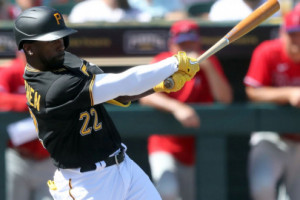
Pick on the Pirates offense! You’ve probably noticed this one already. (If you haven’t, you’ve probably been losing money over the last couple weeks!) But over the last two weeks, the Pirates have the second-best wOBA and the second-best wRC+ in baseball. They are also striking out at a below-league-average rate. A lot of this probably has to do with McCutchen’s turnaround (which probably, largely, has to do with improved health). But “knowing the reason” is not what’s important for you. What’s important for you is, simply, knowing that this is the case.
Pick on the Angels offense! I was beating the drum more loudly than anyone on this… and while I benefitted for several weeks from upgrading right-handed pitchers against the Angels, I also absorbed a couple tough blows by shifting off this one too late. Over the last two weeks, the Angels are third in baseball in wRC+, and they are third in baseball in ISO. A lot of this damage has been done against right-handed pitching, as Pujols has turned things around recently in a big way, and this has buoyed the entire lineup.
The Rangers are tough on lefties: This may still be true to an extent (that “extent” being: against mediocre lefties), but they are not currently a matchup to avoid against high-strikeout lefties. “Um… I never thought they were.” Well, you should have! For a while, the Rangers were a tough team for lefties to strike out. But with Beltre out of the lineup for now (and Gallo in his place), the opportunities for strikeouts from lefties have been drastically increased. This alone makes a big difference, but this also affects the hitters in the rest of the order, making this a fine team to target with high-K lefties.
Pick on the Brewers offense! I’m being a bit proactive with this one, as the numbers do not yet fully line up with the idea we should no longer be picking on the Brewers offense. But listen: this was one of the best offenses in baseball last year, and the pieces that made them “one of the best offenses in baseball” are starting to look like themselves once more. With Gomez, Braun, Lucroy, Lind, and Aramis at the top of this order, I’m going to give it some time before I go back to upgrading pitchers against them.
The Nationals strike out a lot: While the Nationals are, obviously, a scary lineup, they have still been a team we could go to for strikeouts. As we have seen in the offenses above, however, the complexion of an entire offense can often change with the return (“return from injury” or “return to form”) of one key piece in the lineup. With Anthony Rendon back in place near the top of the Nationals order, I’m much more afraid of them than I was a week ago.
The Royals never strike out! This is a strange one. I haven’t used a pitcher against the Royals in over a year, as their ability to consistently put the ball in play significantly decreases the upside a pitcher has. But we are going on two full weeks now of the Royals having a 22% strikeout rate. Yes, they faced some high-K pitchers over the last couple weeks… but last year, and earlier this year, that would not have mattered. This team seriously does not strike out (“did not” strike out?), and paying up for a high-K guy against them was almost always going to leave you disappointed. I’m on board now, though. Bring on the high-strikeout guys; I’ll use them against the Royals!
You should always check Twitter to see if I am using Cueto: Seriously. This is perhaps the most important trend of all. If I am using Cueto, you should stay far away, as he is not going to record more than 4 strikeouts, and he will probably give up several runs. But if I am not using Cueto, you should be all over him, as he’ll probably strike out 10 guys and give up 0 runs, and – heck – maybe even hit a home run of his own to boot.
If you are dealing with “drafting block,” my friends, it’s time to hit the batting cages and figure out what needs to be adjusted. And as you do so, use the trends explored above to help you gain an edge!
Now go forth, and profit. And let’s make a date to meet up later this week at the top of the leaderboards.