
Masters Pool Picks: The Proven 3-Step Strategy That Separates Winners


Editor’s Note: This guest post is from PoolGenius, a provider of data-driven picks and tools that have helped pool players win at more than three times the expected rate.
If you are looking for Masters pool picks, chances are you have seen these contests before. You have probably been invited into one with friends or family, or seen them on sites like Splash Sports.
No matter the format (tiers or pick a number of golfers) or where you are playing, people usually treat these contests the wrong way. They approach it like they just need to grab big names, lean on the best odds, or mix in a little bit of both, and call it a day.
That will only get you so far. And most of the time, it is not in a cashing position.
Here are three tips to make smarter Masters pool picks. And the third one is what actually separates winners from the rest of the pool.
Get Straight to Making Better Masters Pool Picks
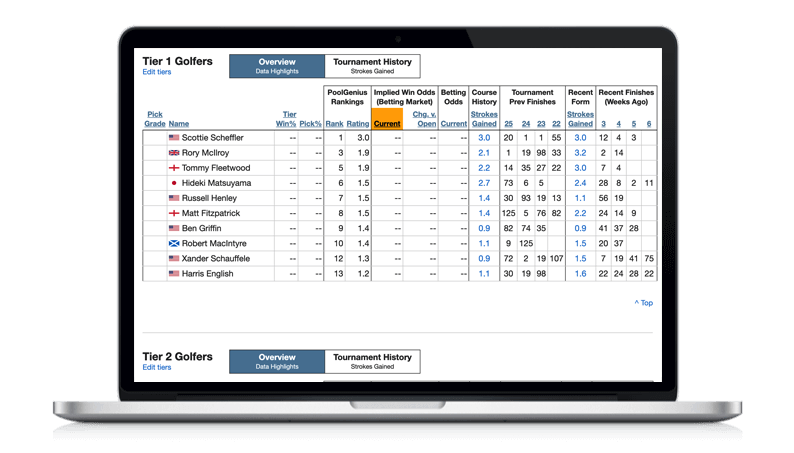
If you want to skip the tips and just get everything you need to make the best Masters pool picks for your specific pool setup, check out the PoolGenius Masters and Majors tool.
It pulls together the key pieces that actually matter. Odds, win probability, stats, course history, all in one place.
You can import your exact pool format, including tiers and scoring, and it will show you how everything lines up for your contest.
The secret sauce is that it aggregates pick popularity data from major pool-hosting sites, so you can see where the field is going and where the best leverage points are to counter it.
Instead of guessing, you are working with a full picture.
If you are in a Masters pool, or a few of them, and you are taking it seriously, it is worth checking out.
GET THE MASTERS PICKS TOOL
Tip 1: Start With Odds as Your Baseline
Before you get into anything else, you need to ground yourself in something objective.
That is what betting odds give you.
They are not perfect or the end-all, be-all of making savvy Masters pool picks. However, the odds are the best single snapshot of how good each golfer is heading into the tournament. They already account for form, long-term skill, course fit, and everything else people tend to debate on their own.
And in Masters pool picks, especially tier-based formats, this matters more than people realize.
Inside a tier, golfers are grouped together, but they are rarely equal. There is usually a real gap between the top and bottom options, even if they look similar on the surface.
You will see it if you line them up by odds.
Over time, the golfers with the strongest odds in each tier outperform the rest. The ones at the bottom of the odds list are far more likely to finish near the bottom of the tier than they are to win it.
Where people go wrong is skipping that process entirely. They jump straight to narratives like recent finishes, course history, or just a name they are comfortable clicking.
That is how you end up passing on better golfers without realizing it.
Start with odds. Make your adjustments from there, not the other way around.
Tip 2: Make Picks Based on Pool Size and Scoring
Once you have your baseline, this is where the strategy actually starts to separate.
Because the right picks change depending on your pool.
A lineup that wins a 20-person pool is not built the same way as one that wins a 300-person pool. This seems like common sense, but the majority of your Masters pool is likely ignoring this.
In Smaller Pools, You Are Keeping Yourself in a Position to Win
If you are playing in a smaller group, you do not need to force differentiation.
There are already enough possible combinations across tiers that your lineup will not be duplicated often. Even if you lean toward the best golfers in each tier, you will still end up with a unique enough combination.
So in these pools, it’s best to focus on:
- Taking the strongest golfers by odds
- Avoiding obvious downside
- Letting other people take on unnecessary risk
You do not need to hit every perfect pick to win a small pool. You just need to avoid getting knocked out by a bad one.
In Larger Pools, You Need a Lineup That Can Actually Separate
As the pool gets bigger, the dynamic changes.
Now you are much more likely to run into other entries that land on the same top performers. If you build a lineup that looks correct across the board, there is a good chance several other people did the same thing.
That lineup can score well and still not win.
So now you need to think differently.
You still want strong golfers, but you also need a path where your lineup beats a large chunk of the field. That usually means identifying a few spots where you are willing to move off the most obvious pick.
Identifying those spots is the heart of tip No. 3.
Your Scoring System Should Change How Aggressive You Are
This is another place where people mess up. They use the same approach regardless of how the pool is scored.
If your pool is based on prize money or finishing position, you need upside.
You are not winning without top finishes. That means you should be more willing to take chances on golfers who can contend, even if they are less consistent.
If your pool is stroke-based with penalties for missed cuts, that’s a different conversation.
Now, a missed cut can completely sink your lineup. In that format, you should be much more focused on golfers who are likely to make the cut and avoid big numbers.
You are managing downside more than chasing ceiling.
If your pool drops your worst score, that changes things again.
Now you have room to take a shot on a volatile player in one of the tiers, because a bad result does not automatically kill you.
Most people do not adjust for any of this. They just pick golfers they like and hope it works out.
If you are not matching your Masters pool picks to the structure of your pool, you are giving away an edge before the tournament even starts.
Tip 3: Use Pick Popularity to Create Leverage
Everything up to this point gets you to a solid lineup. Creating leverage based on pick popularity is what gives you the best chance to win.
Because again, your goal is not just to score well. It is to outscore your opponents, and that means you have to think about what they are doing.
If a golfer is going to be picked by a large percentage of your pool and he plays well, that does not help you much. You move up with everyone else.
But if you can find a golfer with a similar chance to perform, who is being picked far less often, that is where things get interesting.
If that golfer outscores the popular one, you are gaining ground on a big portion of the field in a single decision.
That is the kind of move that wins pools.
What You Are Actually Looking For in Each Tier
You are not trying to be different for the sake of it.
You are looking for situations where:
- Two golfers have similar odds of performing well
- One of them is going to be picked much more often
In that spot, the less popular golfer is usually the better play from a strategy standpoint.
You are giving up very little in expected performance but gaining a lot in potential leverage.
How to Estimate Masters Pool Pick Popularity
The problem is that it’s difficult to estimate pick popularity on your own. Sure, you can make some educated guesses.
You know the big names will be popular. You know recent winners will get attention. You can look at odds and make assumptions.
But once you get past the obvious spots, it becomes guesswork.
And if you are guessing, you are probably missing the best opportunities to pivot.
This Is Where the PoolGenius Masters Picks Tool Helps
At a certain point, this becomes a lot to manage.
You are weighing odds, thinking through scoring, gauging pick popularity, and figuring out how it all fits together into one lineup.
You can do it manually. It just takes time, and you are still guessing in a few spots.
That is where the PoolGenius Masters and Majors tool comes in.
Instead of trying to piece this together yourself, you can see everything in one place:
- Odds and win probability
- Course history and key stats
- Pick popularity and where the field is leaning
- Clear value spots and pivots within each tier
You enter your pool details, and it aligns all of this to your specific format.
So instead of guessing where to be different, you can be intentional about it.
If you are serious about making smarter Masters pool picks, this is the simplest way to actually apply everything we just talked about.
GET THE MASTERS PICKS TOOL
Interested in trying out PGA DFS? Check out RotoGrinders’ PGA DFS sims tool (SimLabs) and everything else RotoGrinders has to offer.