
Tale of the Tape: Is McKinnon For Real?

Are the Vikings on the Verge of Passing the Torch at Running Back?
So far this season, Matt Asiata has been the lead back for the Minnesota Vikings, seeing most of the carries and targets in the passing game out of the backfield. But the former Utah tailback was never supposed to be a star at the NFL level.
After going undrafted out of college, he bounced from practice squads to the UFL before finally making the Minnesota roster in 2012.
He never had more than 155 carries in a season in college, and barely eclipsed 2000 yards from scrimmage over his career for the Utes. He did score his fair share of touchdowns, though, finding the end zone 26 times on just over 400 touches, and that trend has continued into the NFL.
Asiata has seen 10 of the team’s 14 red-zone carries given to running backs, and three of the 11 red-zone targets in the passing game. He’s third on the team in overall targets, and has more carries than all other backs on the team combined. He’s clearly been the lead dog.
But on Sunday, we started to see how his role will be diminished as the season progresses. Rookie Jerick McKinnon, a triple-option quarterback and running back a year ago for Georgia Southern, put his freakish athleticism on display against the Falcons, and likely shifted the balance of the Minnesota backfield moving forward.
Let’s go to the tape to see what I mean.

This was McKinnon’s biggest play of the afternoon, and it was a combination of a good play call, good execution from his linemen, and lots of creativity and athleticism on his part. It’s a draw play deep in Minnesota territory, and it works as intended.
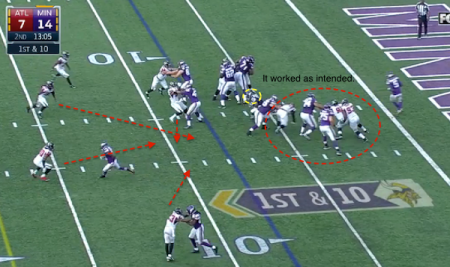
But this play could have been over at the second level, as McKinnon had quite a few defenders with an eye on him and a shot at closing him down. We’ll come back to this in a second.

Asiata also found himself in this situation, running a draw on 3rd-and-2. The playcall wasn’t quite as innovative, and the execution wasn’t as good, but he was still provided a good opportunity.

Several Atlanta defenders get caught up in the pass action of the play, leaving plenty of room at the second and third level for Asiata. But he’s just not quick enough to pull away from the linemen in pursuit, and doesn’t have the speed or moves to do anything in the open field against the closing linebackers and defensive backs.

As a result, the play ends in a first down and a nice gain, but it could have been more were it McKinnon carrying the ball.

Back to McKinnon’s play, we can see that his speed to and through the line of scrimmage has several Atlanta defenders backpedaling to make sure he doesn’t break a home-run play. Players numbered 20 (Dwight Lowery) and 23 (Robert Alford) have given up five yards of ground to make sure they still have an angle on the speedy McKinnon.

This play went on for a while, as the shifty runner tried to wait for Cordarrelle Patterson to block for him, and eventually tried to cut across the field before being taken down for a huge gain. But he showed speed and moves that Asiata simply doesn’t have.
That speed translates to making big plays down the field, but it also changes how a back approaches a play at the line of scrimmage.

Here McKinnon sees his left tackle getting pushed back into the backfield, and a linebacker ready to seal the edge and prevent a run to the left from going anywhere. This is a play where Asiata would lower his head and duck upfield.

But not McKinnon. He reverses field and then makes another nice cut to get six yards on a play that probably would have netted zero with the Vikings’ other back in the game.
Asiata has carried the ball 94 times in his NFL career, and has one play of over 12 yards, and only five runs with double-digit yardage. McKinnon has only 23 NFL carries, but has three double-digit runs already.
This isn’t news to anyone who studied McKinnon coming out of college, though. The former GSU Eagle was better in every NFL Combine measurable than Asiata. His 40-yard dash was .4 seconds faster, his vertical was 10 inches higher, and his broad jump was over 2 feet longer.
Even his bench press was more impressive, despite Asiata’s 20-pound weight advantage. Everything about McKinnon screams “explosive playmaker.” So why isn’t he getting all of the looks for the Vikings yet?
Playing in a triple-option scheme in college (and often playing the quarterback position), McKinnon is not an accomplished catcher of the football. And after last week, when he dropped a perfect Teddy Bridgewater pass on the sidelines, he repeated the effort on a short throw over the middle against Atlanta.

First off, apologies for the poor quality of the above picture. Here, there is contact, but it’s not any sort of violent contact, and McKinnon got both hands on a very catchable, short pass. He simply let it go through his hands, something he must improve to earn more playing time.
So what does this mean for fantasy football? The Minnesota running back situation is about to become a bigger headache than it has been for the first few weeks. McKinnon’s performance against Atlanta is too good to ignore, and he’ll continue to see the field.
But he’s limited in the same way Chris Ivory and Khiry Robinson are, in that he’ll not be on the field for passing downs as often as other backs with more accomplished receiving histories. Asiata is a reliable pass catcher, and will almost certainly keep a big role in the offense because of it.
So, this is shaping up to be a situation similar to that in Buffalo, where the older, slower back who can catch and is good in the red zone will continue to be a viable option, but the younger, quicker back is always a threat for the huge play and big fantasy output.
Price, Vegas odds and injuries will dictate whether or not Asiata and McKinnon are an “obvious” DFS pick moving forward, but after Sunday’s performance, it’s pretty clear that McKinnon has what it takes to be a game-changing back in the NFL. He just has to earn more playing time by getting all the fundamentals right.