
MLB DFS: The Good and the BABIP

The MLB season is flying by and as we get into the summer months, we can get more and more useful information from the current year’s stats. Because players salaries fluctuate based on their surface stats, you can find highly skilled players at low salaries who have simply had bad luck thus far in 2015. On the flip side, some players may have gaudy numbers for the first two months, but their skill set simply does not match their high salary, and you are better off letting your opponents overpay while you spend that money elsewhere in your lineup.
In my last piece on home runs, I looked players who had unusually high or low HR/FB rates through the early part of the season. I am going to do a similar exercise, but this time looking at BABIP, batting average on balls in play, to find players who are over and underperforming thus far.
BABIP is generally considered a “luck-based” statistic for pitchers, in that all pitchers regardless of skill end up clustered around the league average .300 BABIP. Hitters are a little different in that they do have some control over their BABIP, and throughout their careers, they set their own baselines. Generally, a majority of hitters still end up pretty near the .300 mark, but players with consistently high line drive rates, or speedy ground ball hitters can have high BABIPs, while slow players with heavy fly ball tendencies have a lower BABIP.
To find outliers, we need to look at three key numbers; Historical BABIP, strikeout rate, Ground Ball/Line Drive/Fly Ball Rate. BABIP takes a long time to stabilize, so we need to see a couple season’s worth of BABIP data on a hitter to know what his baseline is. We also need to make sure a player is not displaying a change in underlying skills in contact rate or hit distribution (GB/LD/FB).
But, if a player’s plate discipline and batted ball profile stays the same, his BABIP should regress to his career average, whether that means it will come up or go down.
Here is a look at some players with a low BABIP that could be due for improvement, as their salaries have fallen due to bad luck more than bad skills. The 2015 data is as of May 29th.
Hanley Ramirez
Career – 16.5% K, 45/19/36 GB/LD/FB, .330 BABIP
2013 – 15.5% K, 41/22/37 GB/LD/FD, .363 BABIP
2014 – 16.4% K, 45/21/34 GB/LD/FB, .323 BABIP
2015 – 15.0% K, 46/21/32 GB/LD/FB, .248 BABIP
My take on Hanley Ramirez – I’m starting with the easy one; Ramirez is an elite hitter, hitting in the middle of a great lineup, and there is nothing to be worried about with him going forward. The low BABIP is clearly an outlier, and as long as he’s healthy, he’s going to hit. His salary, especially on FanDuel, is at a very low point, and I’m going to keep buying in at this level.
Albert Pujols
Career – 9.8% K, 41/19/40 GB/LD/FB, .301 BABIP
2013 – 12.4% K, 38/20/42 GB/LD/FB, .258 BABIP
2014 – 10.2% K, 46/19/35 GB/LD/FB, .265 BABIP
2015 – 12.0% K, 43/18/39 GB/LD/FB, .236 BABIP
My take on Albert Pujols – Pujols has seen an obvious drop in all his numbers across the board from his peak when he was the best hitter in the game. His BABIP from 2013-2014 appears to be his new baseline, where his peak seasons when he had more speed, he was over the .300 mark. But this is still a very good hitter that should see his BABIP back up around the .260 mark with plenty of power and RBI. He still has excellent control of the strike zone for a hitter with his amount of power.
Chase Utley
Career – 14.6% K, 38/21/41 GB/LD/FB, .301 BABIP
2013 – 14.9% K, 38/20/42 GB/LD/FB, .305 BAIP
2014 – 12.8% K, 39/25/36 GB/LD/FB, .295 BABIP
2105 – 15.0% K, 44/20/36 GB/LD/FB, .197 BABIP
My take on Chase Utley – I know this one is more controversial than someone like Hanley Ramirez, a lot of you probably think Chase Utley is just done being a useful fantasy player. And it is possible that he is. The older players get, the more a drop in production is likely to be real. The only thing that gives me pause is that he does have a degenerative knee condition, but his underlying numbers look like those of a solid major league hitter that has simply had bad luck. I am not telling you to run out and roster Utley every day, but I don’t think he should be written off completely.
Carlos Gonzalez
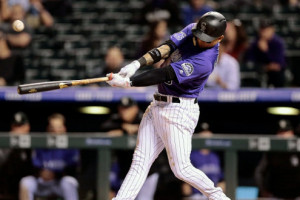
Career – 22.2% K, 45/20/35 GB/LD/FB, .339 BABIP
2012 – 19.9% K, 49/22/29 GB/LD/FB, .352 BABIP
2013 – 27.1% K, 38/22/40 GB/LD/FB .368 BABIP
2014 (half season injury) – 24.9% K, 47/15/38 GB/LD/FB, .283 BABIP
2015 – 19.8% K, 53/22/25 GB/LD/FB, .243 BABIP
My take on Carlos Gonzalez – Gonzalez has some interesting metrics to look at. Prior to an injury-shortened 2014, he always carried a very high BABIP. It is possible that because he’s had so many injuries in his career, his fall to the .283 BABIP last season is more real than not, although I think it still would have ended up over .300 in a full season of at-bats. His strikeout rate and batted ball profiles have jumped around a little bit, so I don’t know if we should expect his high ground ball rate to continue as this season progresses. What I do know is that he is not going to have a .243 BABIP, especially playing in Coors Field. Much like Hanley Ramirez, his salary is simply too low for a player of his skill level. I am still buying in on CarGo.
Let’s move on to some players who are likely to see their number decline as we move into the summer.
Jimmy Paredes
Career – 26.7% K, 53/21/26 GB/LD/FB, .348 BABIP
2013 (135 PA) – 32.6% K, 60/20/20 GB/LD/FB, .280 BABIP
2014 (65 PA) – 24.6% K, 56/22/22 GB/LD/FB, .356 BABIP
2015 – 23.7% K, .406 BABIP, 47/26/27 GB/LD/FB, .406 BABIP
My take on Jimmy Paredes – I am sure there are quite a few DFS players who have been rostering a player they’d never heard of prior to this season, and loving every minute of it. Paredes doesn’t have a long enough track record to have a baseline BABIP that we can count on. Because he has good speed and keeps the ball on the ground, it’s possible his career .348 BABIP is in play for him. But this over .400 start to the season is not going to continue. Coupled with his 20% HR/FB (10.4% career), Paredes is going to be coming back down to earth.
Nelson Cruz
 Nelson Cruz" alt="Nelson Cruz" />
Career – 22.2% K, 40/17/43 GB/LD/FB, .303 BABIP
2013 – 23.9% K, 42/17/41 GB/LD/FB, .295 BABIP
2014 – 20.6% K, 42/17/41 GB/LD/FB, .288 BABIP
2015 – 24.6% K, 42/17/42 GB/LD/FB, .387 BABIP
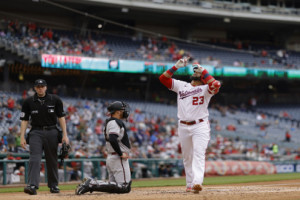
My take on Nelson Cruz – Cruz also appeared on my HR/FB overachievers list a couple weeks ago, as he is having a great start to the season. And while he is a legitimate power threat, everything is falling his way at an unsustainable level. He has always had a very low line drive rate and high fly ball rate, keeping his BABIP very steadily around the .300 mark or below. There is nothing to suggest that this high BABIP is going to continue. He is always worth a tournament play for HR upside, but his batting average is going to be at his historic .260-.270 rate the rest of the way, not the .340 that is at currently.
Prince Fielder
Career – 17.1% K, 41/20/39 GB/LD/FB, .306 BABIP
2012 – 12.2% K, 41/26/33 GB/LD/FB, .321 BABIP
2013 – 16.4% K, 41/23/36 GB/LD/FB, .307 BABIP
2104 – (injury shortened) – 13.5% K, 50/19/31 GB/LD/FB, .274 BABIP
2015 – 12.0% K, 43/21/36 GB/LD/FB, .380 BABIP
My take on Prince Fielder – To put it real simply, 275lb first baseman do not have .380 BABIP’s. Fielder is awfully spry for a bigger fellow, but his early season batting average surge is more fluke than fact. I still like Fielder going forward with his solid contact rate, but can’t often recommend him as a cash game play at his current salary level.
Jason Kipnis
 Jason Kipnis" alt="Jason Kipnis" />
Career – 18.3% K, 45/24/31 GB/LD/FB, .316 BABIP
2012 – 16.2% K, 47/23/30 GB/LD/FB, .291 BABIP
2013 – 21.7% K, 43/25/32 GB/LD/FB,.345 BABIP
2014 – 18.0% K, 46/23/31 GB/LD/FB, .288 BABIP
2015 – 12.8% K, 44/28/28 GB/LD/FB, .382 BABIP
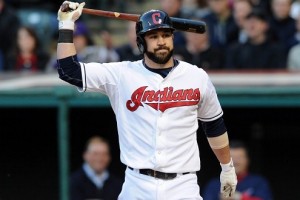
My take on Jason Kipnis – I put this one in here for myself, as I have a problem with liking Jason Kipnis too much. He carried a high BABIP for a full season in 2013, so it’s possible he does have the ability to sustain a high BABIP, though it was surrounded by a couple sub .300 years, . And, I like the fact that he has lowered his K rate and is hitting more line drives. I like everything, I like Jason Kipnis, except… I don’t like the current salary, and I don’t like the high BABIP. Even if his .345 from 2013 was real, he still has a ways to fall, and his batting average is going to come with it. There is really no way he should be significantly higher priced than Jose Altuve. He’s playing great, I’m a huge fan, and I’m telling you, no I’m telling me, be wary of overpaying.
I hope you are finding this analysis useful, it can be very tricky in DFS to know when to ride a hot streak and when to lay off and wait for the numbers to regress. Sometimes these players can over or underperform for a long stretch of time, but eventually the numbers win out. As always, there are many ways to go about building your DFS lineups, my goal is to help you understand the numbers and what they mean. How you choose to use them, that’s up to you.