
Underdog's The Albatross: Majors-Only Best Ball Strategy

Underdog’s The Albatross 2026 Strategy Guide: PGA TOUR Majors Best Ball Explained
Underdog’s The Albatross is one of the most popular long-term golf contests on the platform, offering a majors-only best ball format with an aggressive elimination structure and a top-heavy prize pool. Unlike weekly PGA DFS, The Albatross rewards long-term planning, major championship knowledge, and disciplined roster construction.
This guide breaks down The Albatross (2026) format, scoring, payouts, and optimal draft strategy so you can build competitive rosters for the entire PGA TOUR major season.
Want to get in on the action? Check out our Underdog promo code and get drafting today.
What Is The Albatross on Underdog?
The Albatross is a PGA TOUR majors-only best ball tournament that spans all four men’s major championships:
- The Masters
- PGA Championship
- U.S. Open
- The Open Championship
Each major represents a separate elimination round. Teams must advance through every round to reach the final, making The Albatross one of the most fun golf contests on Underdog.
Contest Format and Draft Rules
- Entry Fee: $15
- Draft Size: 6 teams
- Roster Size: 12 golfers
- Scoring: Best 6 golfers count automatically each major
- Draft Options:
- Live drafts (30 seconds per pick)
- Slow drafts (up to 8 hours per pick)
There are no waivers, trades, or in-season roster moves. Once the draft ends, your roster is locked for the entire majors season.
Advancement Structure for The Albatross
Understanding the advancement rules is critical. This is not a cumulative scoring contest.
Elimination Rounds
- Round 1 – the Masters:
- 6 teams
- 1 team advances
- Round 2 – PGA Championship:
- 5 teams
- 1 team advances
- Round 3 – U.S. Open:
- 5 teams
- 1 team advances
- Round 4 – The Open Championship:
- 200 teams compete in the final
Fewer than 1% of all entries advance to the final round.
Prize Pool and Payouts
- First Place: $50,000
- Minimum Payout in Final Round: $500
- Advancing from Round 1: Entry fee refunded
The payout structure is extremely top-heavy, pushing optimal strategy toward ceiling outcomes rather than conservative finishes.
The Albatross Scoring Format
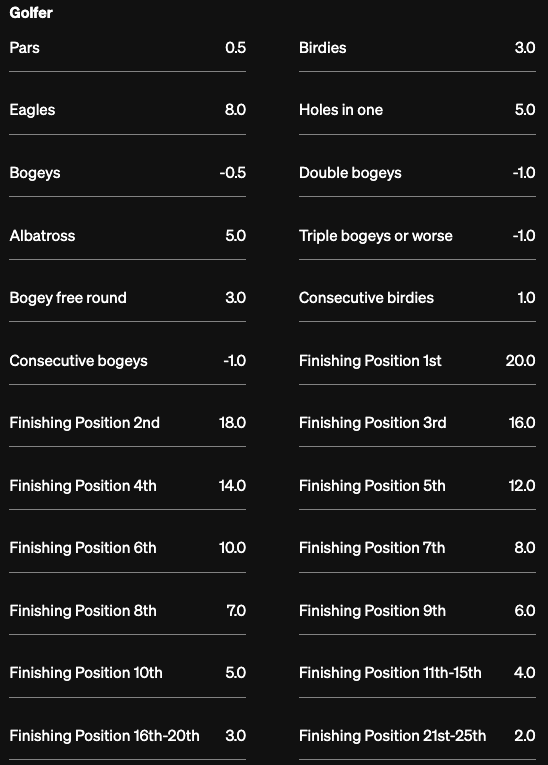
The 2026 Albatross brings us a scoring style that favors good performance rather than volume. The scoring is different from 2025; however, if you have drafted any PGA Best Ball (think of The Scramble) then the scoring is the same as those 2026 events. You can see the scoring format for 2026 below:
Why the Masters Is the Most Important Major
The Masters is one of the most important tournaments in The Albatross.
With only one team advancing out of six, Augusta National acts as the largest bottleneck in the entire contest. If your roster does not survive the Masters, the rest of the season becomes irrelevant.
- Masters course history carries more weight than usual
- Golfers not qualified for the Masters should be avoided
- Early draft capital should prioritize Augusta performance
An average lineup has a 17% chance of advancing out of the Masters round, while an average lineup would have a 20% chance of advancing out of the PGA Championship or U.S. Open round. It is important to draft with the Masters in mind.
Core Draft Strategy: Major Championship Qualification
The most important factor in Albatross roster construction is major eligibility.
Any golfer who misses a major creates a dead roster spot for that round, severely limiting your ability to field six scoring golfers.
Priority Player Profiles
- Golfers already exempt into all four majors
- Golfers on track to qualify for all four majors
- Consistent top-tier OWGR players
- Players with long exemption windows
These golfers reduce structural risk and should form the foundation of most builds.
Managing Risk With Fringe Qualifiers
Mid-round and late-round picks often include players who are projected to qualify for majors but are not fully locked in. It is also important to note that not all tentative qualification looks the same. Let’s take a look at a few cases:
Marco Penge is currently being drafted 51st in these drafts. He has already locked up spots in all of the majors except for the PGA Championship. He is in the PGA Championship as of Feb. 5th but has not officially secured a spot. The top 100 in the OWGR usually get into the major via special exemption, and he currently ranks 31st in the OWGR. It is very likely that Penge gets in the PGA, making him a contestant in all 4 majors. This is a safe late-round pick if you are looking for someone that will play in every major.
On the other hand, let’s look at Tony Finau. As of Feb. 5th, he has tentatively qualified for the PGA Championship the same way Penge has. However, Finau currently sits at 100th in the OWGR. He is much more likely to lose his qualification than Penge, making him a riskier pick. Not all tentative major competitors have the same chance of competing.
Moderation and diversification are key when drafting these players.
Optimal Roster Construction Tips
Prioritize Masters Performance Early
- Favor golfers with proven Augusta success
Surviving Round 1 is the first objective.
Balance Ceiling and Stability
To advance through all four rounds, rosters need:
- Rosters of AT LEAST 6 golfers in every major, preferable 8+
- Win equity and top-five upside
- Enough consistency to survive early eliminations
Pure volatility rarely advances, but overly safe builds struggle to win the final.
Plan for The Open Championship
The final round takes place at The Open, often on links-style courses that reward:
- Elite iron play
- Wind control
- Experience on firm, fast layouts
Multiple links-capable golfers can provide a meaningful edge in the final round.
Avoid Dead Roster Spots
- Golfers unlikely to qualify for majors
- Players dealing with injuries or uncertain status
- Limited access to the majors
These profiles rarely justify their upside in this format. Here is an example of a roster that I drafted:
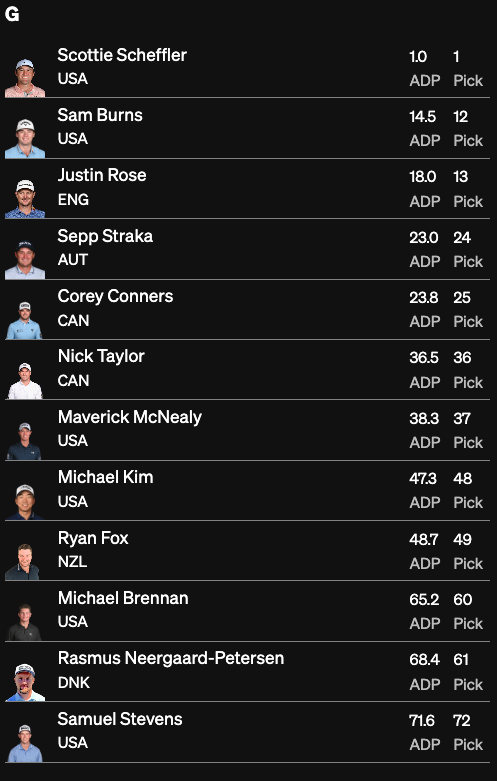
On this roster, I have 12 players that are currently qualified for every major this season. Scottie Scheffler and Justin Rose are guaranteed to be in every major no matter what.
Scottie Scheffler, Justin Rose, Corey Conners, and Ryan Fox have played well in the Masters. This sets us up nicely to advance out of the first round and have plenty of players that will play in the later majors.
Golfers That Have Qualified for all Majors
Below is a table of all of the golfers that have qualified for all of the majors in 2026:
| Scottie Scheffler | Bryson DeChambeau (LIV) | Chris Gotterup |
| Tommy Fleetwood | Harris English | Justin Rose |
| Rory McIlroy | Keegan Bradley | Brian Harman |
| Ben Griffin | Justin Thomas | Wyndham Clark |
| Xander Schauffele | Collin Morikawa | Brooks Koepka |
| J.J. Spaun | Cameron Young | Jon Rahm (LIV) |
| Matt Fitzpatrick |
Final Thoughts on Underdog’s The Albatross
The Albatross is one of the most skill-intensive golf contests available on Underdog. Success requires:
- Understanding the elimination structure
- Prioritizing Masters performance
- Minimizing qualification risk
- Drafting for ceiling outcomes
Think in rounds. Build rosters that can survive Augusta, peak at The Open, and give yourself a realistic path to the $50,000 top prize.
Want to trade on any golfer to win a major this season? Use our Kalshi promo code and check out the complete list of golfers and their odds to win a major this season.
Image Credit: Imagn