
JMToWin's MLB Edge: Tuesday, April 14th


Each Tuesday & Friday this MLB Season, the legendary JMtoWin (2014 DK WBC Atlantis Finalist, 2014 DSBC Finalist x2) will bring you premium DFS MLB analysis like no one else in the industry can. A top-tier Grinder, and a professional writer, FD & DK subscribers can expect only the best quality throughout MLB season. Check out a sample of JMtoWin’s work from this NFL season here.
Editor’s Note: This column will soon only be available for DraftKings and FanDuel incentives subscribers. Enjoy our free preview period – here’s a taste of what you’ll get!
MLB Edge: An Explanation Of Current DraftKings Pricing
Welcome to the past!
Seriously. It’s as if DraftStreet has risen from the dead.
If you joined the world of daily fantasy sports at the start of NFL, there is a chance you have never even heard of DraftStreet.
“What is this ‘draft street’?” you may be asking (you may also be asking how you can buy a house on said street – which is a common point of confusion; it’s not actually a real street, you see).
Up until late last summer, DraftStreet was the third largest daily fantasy sports site – behind FanDuel and DraftKings (and by “third largest,” that basically meant “third largest, but WAY smaller than the other two”). DraftStreet was actually where I got started in daily fantasy sports – and if you talk to those who used to play on DraftStreet, they’ll speak of the site with that sparkle-in-the-eye usually reserved for talking about a favorite grandparent who passed away years ago. People who played on DraftStreet absolutely LOVED it! One of the reasons the site never really grew, however (and this is just conjecture, but there is plenty of reason to believe this is entirely accurate), is because it was too difficult. The pricing was so sharp, it was sometimes ridiculous. (Not only that, but in MLB, you had to roster three pitchers – with the option to roster at least one reliever (don’t even get me started on the strategy that went into that!) – and you had, if I remember correctly, a DH spot in which you could put a hitter from any position.) The difficulties inherent in putting together a top-notch roster on that site made the site appealing to players who really have a knack for this whole DFS thing, but the same things that made a small handful of players absolutely love the site also made the site uninviting to new players.
FanDuel and DraftKings have both been criticized at times for having pricing that is too easy. But honestly, what new player wants to play on a site where it takes them two weeks to figure out how to even put together a competitive roster?
One thing that is interesting between FanDuel and DraftKings, however, is that FanDuel’s pricing remains fairly consistent…whereas DraftKings’ pricing approach seems to always be changing. Sometimes, DraftKings pricing is tighter than FanDuel’s. Sometimes, it’s looser. I remember one week during NFL when the pricing minimum and maximum for defenses suddenly changed entirely! I remember when last season started, and QB pricing was way lower than it had been the year before. I remember the weekend of the first Millionaire Maker during NFL when DraftKings made their prices far lower than normal across the board (presumably, so that newer players would be able to roster a lot more top names).
Maybe you complain about these constant changes in pricing approach. Personally, I think it’s kind of fun – and it adds a dimension of strategy, as you have to adjust your approach to roster construction to fit the pricing.
Lately, DraftKings has started doing something they have not done before: they have started pricing MLB players based on matchup! It makes sense that they would try this, as DraftStreet used to do this, and DraftKings acquired DraftStreet last summer (which is why DraftStreet is no longer around, and why you cannot buy a house there).
Players at Coors Field are now priced much higher than players playing in other places.
A right-handed batter facing a left-handed pitcher is now priced higher than they would be on days when facing a right-handed pitcher.
Moreover, a right-handed hitter facing a bad left-handed pitcher is priced even higher!
Look at these prices for Troy Tulowitzki to get a sense of what I’m talking about:
$7,000 – April 10, at Coors Field, in a lefty/righty matchup
$6,000 – April 11, at Coors Field, in a righty/righty matchup
$6,000 – April 12, at Coors Field, in a righty/righty matchup
$4,800 – April 13, at AT&T Park, in a righty/righty matchup
You see that? And that’s happening across the board!
When DraftStreet did this, it was more subtle. But you know what? I absolutely love it! Now, you have to decide: “Do I want to pay $7k for Tulo at Coors Field vs a lefty, or do I instead want to save that money and pay elsewhere?” Or, “Do I take Tulo at a discount in a bad hitter’s park vs a righty, or do I use that money elsewhere?”
I ran into a similar problem on the Saturday afternoon slate. I loved the matchup the White Sox had vs Mike Pelfrey and the Twins, and I planned to use several White Sox bats in my cash game lineup. I built my roster. I felt good. But then, I realized I was paying $5,000 for Melky Cabrera when Giancarlo Stanton was the same price! And sure, Melky was facing a poor pitcher in a righty/lefty matchup (well…a righty/switch-hitter matchup), and Stanton was facing Chris Archer in a righty/righty matchup. But. Come on. Giancarlo Stanton! So I switched to Stanton, thinking I could not justify paying the same for Melky – in any matchup – as I could pay for Stanton. That day, I failed to cash in cash games by about 3 points (a side note: I’ve failed to cash in double-ups twice so far this season…both days, I finished about 2 or 3 points away from cashing; so disappointing!). If I had used Melky, I would have cashed.
But which was the better play? Honestly, I’d have to dig in a lot deeper to tell you! What are Stanton’s career numbers vs righties who allow the wOBA Archer allows to righties…compared to the numbers Melky has over, say, the last three years vs righties who allow the wOBA Pelfrey allows to lefties? Basically, it complicates the matter completely; no longer can you simply say, “Stanton is $5k in a bad matchup; Melky is $4k in a good matchup. Easy peasy!” (Not that you would say “Easy peasy” anyway – but you get the idea.) Instead, you have to ask whether it’s worth it to pay up for Melky, or to take Stanton in a bad matchup at what amounts to a relative discount.
Another side effect of this pricing approach – if things remain this way – is that Coors Field will no longer be stacked as heavily. Why? Because, if you want to fully stack a lineup at Coors Field, you have to scrape the bottom of the pitching barrel to make it work! The other day, I stacked the Rockies vs Hammel (assuming this would be slightly contrarian, as more people would be on the Cubs at Coors Field that day vs Kendrick). Not only was it contrarian…but Arenado was 6% owned that day! Blackmon was 8% owned. Morneau was 10% owned. Even Corey Dickerson was only 12% owned! Only CarGo and Tulo approached 20% that day. (Of course, in order to make this happen, I also had to roll the dice with Jimmy Nelson and Aaron Sanchez at pitcher that day. Nelson: Great! Sanchez: Ouch. I still cashed in GPPs that day, but it hurt more than it should have because my last decision that day was “Aaron Sanchez or Archie Bradley?” Same exact price. I went with the 25% of the field that chose Sanchez and got negative points, instead of going with the 1% of the field that took Bradley and pushed for 30 points. Yeah – that could have been a much better day! Just a little rambling side story for you. Oh – and the side story started because I wanted to point out how cheap I had to go at pitcher to make that Rockies stack happen. Okay, I’ve pointed that out now. Moving on…)
As for the Cubs stack, all those guys were around 18% to 20% owned. This would never be the case with softer Coors Field pricing, as a team with tons of power playing at Coors Field against Kyle Kendrick would have threatened to top 40% ownership before!
Already, I am hurting my resolution to keep these articles shorter (a frustrating development, as this article will disappear from RotoGrinders as soon as the first game of the night starts, so it feels like there is really no reason to write such a long article that people will only be able to see for such a short amount of time!). But to those of you who do get to read this article before it disappears: this is ridiculously valuable knowledge to possess and understand.
One of the main goals of my articles, always, is to help readers grow in their ability to build quality teams on their own. Once you start paying attention to the way in which this new form of DraftKings pricing affects ownership (and the strategy this brings into play as a result), you will find yourself in an excellent position for profit!
The two main things I am seeing, so far, with the strategy that comes into play with the new pricing are as follows:
1) Coors Field will be lower-owned! I mentioned this already, of course, but it’s worth reiterating, as scoring at Coors Field truly can get ridiculous. If you can find great values (especially great values most people will miss) at pitcher on days when there is a great matchup at Coors Field, stacking Coors Field may now be the new “fading Coors Field” in terms of going contrarian with GPP strategy. When the game at Coors Field gets out of hand, you just may be able to get the benefit of those points while also being on the side of low ownership!
2) Big-name players will be higher-owned in bad matchups! Of course, this actually complicates things a little. As I mentioned on Sunday, big-name players always have decent ownership. But when Miguel Cabrera is 15% owned in cash games in a tough matchup, you gain a slight edge on the field when he has a bad game, and you aren’t hurt all that much when he has a big game. But what about now, when Miggy in a tough matchup is priced the same as a lesser player in a great matchup? In the example above of Stanton and Melky, after all, Stanton was 40% owned, even though he had a tough matchup and cost 10% of total budget. Matchup went out the window when people saw how underpriced he was relative to other, lesser hitters! My early assessment of this second point is that this will require you to dig a bit deeper into the matchups facing these “underpriced” top players. When the matchup is not really all that tough, it may often be best to side with the field. On the other hand, when you can dig in and see that it truly is not a great matchup for that “top hitter who will be highly owned,” you may simply want to stay away! Sure, there will be days when this highly-owned player goes off…but if you are properly assessing your research, you will be on the positive side of things far more often than not, as those who are tying up budget in these top hitters will be left wondering why they keep getting so many disappointing scores from them.
TODAY’S SLATE OF GAMES
Because my goal in these articles is to provide you with a unique perspective and approach that you would not be able to find in any other articles, and because my second objective – in my mind – is to put you in a position where you are able to consistently make quality, +EV decisions on your own (that whole “teaching you how to fish” thing), I generally shy away from providing specific, player-by-player suggestions. After all, such suggestions might help you on that specific day, but what does it do for you on all the other days when I am not writing? Instead of simply taking my advice on some of the players playing that day, it is better for you to start understanding how to see all these things for yourself! (Plus, when it comes to MLB, how good is it, really, to give you a bunch of picks? With variance being what it is among hitters, I could look like a genius on one day or like an idiot on another day while making suggestions that are equally good! The only way to combat that is to provide you with a bunch of picks for you to choose from, so that I am assured of being right on at least some of them – and that’s not all that helpful either!)
With that said, however, I have used up a lot of words already on the intro, and – more importantly – I feel like the intro gives you plenty to think about in terms of “strategy” and learning how to see an edge you can gain on your competition (an “MLB Edge,” that is!). Start looking at ownership trends this new pricing is creating, and start seeing how this can help you gain an edge!
In Friday’s article, we will look more closely at how these ownership trends have been shaking out throughout the week, and of how you will be able to take advantage of these trends as you build your teams – so make sure you check back on Friday for that! For now, however, it’s high time we got to today’s slate. And today, I am going to be a bit more straightforward in my picks! Today, we will be looking at four specific pitchers to consider using on your teams…and we will be looking at five specific pitchers to consider targeting with hitters!
PITCHERS TO CONSIDER USING
Daniel Norris – LHP – vs Rays
The Numbers: Norris has been a high-strikeout pitcher in the minors, and there is no reason to believe that will not continue to be the case in the Majors (in fact, his strikeout numbers have gone up at every level – albeit in smaller sample sizes at each level – with a 29% k-rate in 13 games at high-A ball, a 31.6% rate in eight games at AA, and a 44.7% rate in four AAA games!). He walks FAR too many batters, and he’s had a hard time keeping the ball on the ground in his 12 Major League innings, but…

Reasons to consider using: Cheap strikeouts! Yeah. Those are always good to have.
Reasons to consider not using: I don’t know that I could feel comfortable using Norris in cash games, even at his cheap price on DraftKings as a second pitcher. The strikeouts should be there, but while he has shown flashes of brilliance, he has not been able to keep runs off the board consistently at any level. As a tournament play, however, he’ll have some games this year with super high fantasy output, and if you guess right on when those games occur, you’ll be able to free up a lot of extra money for bats!
Carlos Carrasco – RHP – vs White Sox
The Numbers: Last year, Carrasco had a ridiculous 26.5% k-rate, to go with an extremely solid 5.5% walk rate. His 2.55 ERA was backed up by a stellar 2.58 SIERA, and his ground ball rate was an excellent 52.8%.
Reasons to consider using: If this were most days, Carrasco would be a slam dunk to use in your lineups. But there seem to be three “slam dunks” in my mind (Carrasco and the next two guys), and as far as I know there are no three-pitcher sites! His strikeouts and his ability to keep runs off the board make him a clear top play, and I will be very surprised if he does not have the second-highest (or even highest) ownership percentage among pitchers tonight.
Reasons to consider not using: Believe it or not (but you may as well believe it, because it’s true), the White Sox have struck out the fourth fewest times in the Majors to start the season. As we saw with Arrieta against the Cardinals last week, high-strikeout guys will still get strikeouts against teams that emphasize NOT striking out, but Carrasco’s ceiling may be capped if the White Sox have actually changed their high-strikeout ways (although, frankly, it’s too early to say for certain whether or not that is the case, and tonight could be the start of the strikeout regression for the White Sox). Also, a win will be tougher to come by for Carrasco than it will be for the next two guys.
Matt Harvey – RHP – vs Phillies
The Numbers: Obviously, with Harvey, we are looking at 2013 for his numbers, but those numbers in his last full season were stellar: 27.7% strikeout rate, 47.7% ground ball rate, 4.5% walk rate, and 2.63 SIERA.
Reasons to consider using: Harvey is facing a weak-hitting Phillies lineup, and has David Buchanan squaring off against him – meaning he’s in very strong shape for a win tonight (he’s also the biggest favorite on the board today). In my mind, he’s the clear top play of the day at pitcher. If you watched his last start, you know you want to use him.
Reasons to consider not using: One reason to not use him would be to go contrarian in tournaments. I don’t necessarily recommend that on two-pitcher sites, but if you’re throwing in a lot of lineups and want to toss in a few without him, I could see justifying that. The other reason to consider not using him is, I guess, the fact that there are still other good pitchers to play, and one of them could very well have a better day than Harvey (especially if you use a different pitcher and luck into this being a rare day when Harvey simply does not have a feel for his pitches).
Jake Arrieta – RHP – vs Reds
The Numbers: The numbers for Arrieta, Carrasco, and Harvey are all very similar. Last year, Arrieta had a 27.2% strikeout rate, a 6.7% walk rate, a 49.2% ground ball rate, and a 2.83 SIERA.
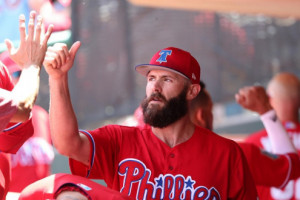
Reasons to consider using: I’ll issue this disclaimer first: I seem to always be higher on Arrieta than others are. Others certainly undervalue him (it’s as though most people are waiting for the pitcher who emerged last year to be proven to have been a fluke), and I probably overvalue him. With that said: I actually like him more than Carrasco tonight. I will be in the minority there, and I could be wrong, but as he’s pitching against a National League lineup (a National League lineup that, furthermore, has the fourth most strikeouts per game in the Majors so far this year), and has a solid likelihood of a win, I’ll side with him as my number two option on the day.
Reasons to consider not using: In cash games, with Carrasco and Arrieta probably being a tossup, I don’t hate the idea of going with Carrasco as your second pitcher to, essentially, provide yourself with insurance by siding with the field. In tournaments, however, I think Arrieta is the preferable play, as he and Carrasco have the same ceiling, and Arrieta will be lower-owned (you could then hope Carrasco has a rare bad game, and that your Arrieta usage vaults you past a large chunk of the field).
PITCHERS TO CONSIDER TARGETING WITH HITTERS
Matt Andriese – RHP – vs Blue Jays lineup
The Numbers: Andriese has sported decent but uninspiring numbers in the minors. He has solid control and a decent walk rate while recording an average strikeout rate, and last year in AAA he held righties to a .656 OPS (while allowing a whopping .803 OPS to lefties).
Reasons to consider targeting him with hitters: He’s a minor league pitcher who is only making a Major League start because of all the injuries to Tampa’s pitching staff. Also, it’s his first Major League start. Also: Blue Jays.
Reasons to consider not targeting him with hitters: Andriese has solid stuff. He’s not a lock to get knocked around by any means and could even hold down the Jays if he has his best stuff. More than likely, his start falls somewhere in the middle of those two potential outcomes, but I certainly like the idea of using some lefty bats against him, and a full Blue Jays stack could pay off in a big way if Andriese comes out without his best stuff in his first Major League start.
Drew Rucinski – RHP – vs Rangers lineup
The Numbers: Here we have another guy making his first Major League start (although Rucinski does have 9 Major League innings under his belt coming out of the bullpen). Like Andriese, he has pretty average strikeout numbers in the minors, and he has solid control and a decent walk rate. He held lefties to a .625 OPS last year, and he held righties to a .708 OPS. Those are reverse splits, of course (not to say that he is definitely a reverse-splits guy, but he certainly was for his first full Minor League season last year) – and those are solid enough numbers.
Reasons to consider targeting him with hitters: Rucinski has never made a start above AA. Sure, he has solid numbers – and his nine innings out of the bullpen have been solid as well – but a start against a Major League team could prove to be too much for him, and the Rangers could take advantage. Furthermore, Rucinski threw 33 pitches out of the bullpen a couple days ago. That may have him on an early hook if he has trouble through the first few innings, which could leave the Rangers facing the Angels bullpen the rest of the way.
Reasons to consider not targeting him with hitters: Rucinski is a good pitcher. That’s reason enough to not target him with hitters! But, again, a pitcher making his first Major League start on the road is never a bad place to throw in some GPP stacks!
Nick Martinez – RHP – vs Angels lineup
The Numbers: Nick Martinez was awful last year, with a strikeout rate of only 12.6%, a walk rate of 9%, and a ground ball rate of only 33% (targeting home runs in Daily Fantasy? – a 33% ground ball rate could help you get there!). His SIERA last year was 5.22, and he allowed a .326 wOBA to righties last year, along with a ridiculous .366 wOBA to lefties.
Reasons to consider targeting him with hitters: The numbers speak for themselves! Using lefties against Martinez is clearly a strong strategy (remember: Calhoun should be back in the leadoff spot tonight), and a full Angels stack is sure unlikely to hurt you!
Reasons to consider not targeting him with hitters: Nick Martinez is not nearly as bad of a pitcher as his numbers make him seem. Instead, you have to take into account the fact that Martinez threw only six games(!) at the AA level before being forced to make the jump to the Majors for 24 starts last year. His first start this year was very good, and if he continued to grow and develop as a pitcher during the offseason, he could have a much better year (and be a far less exciting pitcher to target with hitters) than last year.
David Huff – LHP – vs Mariners lineup
The Numbers: Last year, in 59 innings out of the bullpen (note: bullpen pitchers typically have higher strikeout numbers than starters!), Huff managed only a 15.1% strikeout rate. He has a career SIERA of 4.73, he allows too many fly balls (although he did start to correct this problem last year), and he has bounced between AAA and the Majors for the last six years.
Reasons to consider targeting him with hitters: People will be drawn to Nelson Cruz tonight, as he’s been “on fire” and is facing a lefty. Realize, however, that Huff is not stretched out as a starter and is unlikely to throw more than three innings. That means the lefties in this lineup will have plenty of chances against righty relievers! This game offers a good opportunity to use hitters facing a poor starter for three innings, followed by a bullpen for six innings.
Reasons to consider not targeting him with hitters: I’d be cautious stacking against Huff, as the platoon players who only start against lefties could be pinch-hit for as soon as Huff is out of the game. But a mini-stack (including what should be low-owned lefties!) is a strong idea, and Nelson Cruz is an extremely strong cash game play. (Also, speaking of DraftKings pricing: DraftKings has Mariners players priced to be facing a righty today, as that was the original setup; because they are now facing a lefty – even if just for one or two at bats – these righty hitters are now underpriced.)
Christian Bergman – RHP – vs Giants lineup
The Numbers: Bergman has excellent control (4% walk rate in 10 Major League starts last year) and no chance of getting strikeouts (12.5% rate last year). He also allows a TON of fly balls (32.7% ground ball rate last year, along with an absurd 25.4% line drive rate). Last year, he was a reverse-splits guy, allowing a bloated .340 wOBA to lefties, and an almost unheard of .425 wOBA to righties. He was, of course, much better away from Coors Field (where he allowed a .415 wOBA to hitters overall), but his road wOBA allowed was still .349.
Reasons to consider targeting him with hitters: 1) His numbers. 2) The Giants are pretty good offensively.
Reasons to consider not targeting him with hitters: AT&T Park is, of course, not especially a hitters’ haven. I do expect ownership to be a bit lower on San Fran bats than it should be, as West Coast hitters tend to have lower ownership than games starting early, and people will be scared off by AT&T Park. I would say you definitely want one or two San Fran bats in your cash game lineups, and a full stack in GPP would not at all be a bad idea!
That’s all for today, my friends. Go rock things tonight – and I’ll see all of you on Friday on RotoGrinders (if I don’t see you on Twitter – JMToWin – first!).