
Kalshi vs Polymarket: Which Is Better? (October 2026)

Updated on 10/18/26

Updated on 10/18/26

Kalshi and Polymarket are the two biggest names in prediction markets, but they cater to different trading styles.
Polymarket delivers rapid liquidity and a fast-turning board covering live sports, crypto price targets, and breaking culture markets on its U.S. mobile app.
Kalshi, the longer-established of the two CFTC-regulated exchanges, pairs a desktop order book with the widest funding options, making it a natural fit for economic indicators, political outcomes, and structured sports futures.
Curious about Polymarket? Enter the Polymarket promo code
TL;DR – Kalshi vs Polymarket
- Kalshi wins on desktop trading and funding options (ACH, debit, wire, USDC); the pick if you want a brokerage-style experience.
- With code
GRINDERS for Polymarket andGRINDERS55 for Kalshi, both offers are simple and guaranteed: Polymarket gives a fixed $25 credit on a $10 deposit, while Kalshi pays a flat $55 credit on $25 in trades. - Both are CFTC-regulated, and are unavailable in nine states: AZ, IL, MA, MD, MI, MT, NV, OH, and WA.
- Bottom line: most active traders keep both, trading wherever the market you want has the better price.
- Markets: Kalshi offers a vetted, finance-heavy live menu. Polymarket US offers a broad, fast-turning board spanning sports, politics, pop culture, finance, crypto, and weather. The global menu sits on Polymarket’s international site, which is separate and geoblocked in the U.S.
- Best use case: Kalshi is great if you prefer a traditional brokerage feel. Polymarket is the top destination for traders wanting the largest variety of dynamic, real-time markets.
- What changed recently: In early 2026, the CFTC advanced its prediction-market framework with a March advisory and a June proposed rule. Kalshi and Polymarket added Washington to their excluded-states list; Kalshi’s welcome offer with code GRINDERS55 rose from a flat $25 to a flat $55 on the same $25 in trades, and Polymarket US revised its fee schedule.
Kalshi vs Polymarket: Bonus Offers
| 🔮 Platform | Kalshi | Polymarket |
| ⭐ Promo Code | ||
| 💰 Welcome Bonus | ||
| 📖 Terms & Conditions | ||
| ❌ Not available in | AZ, IL, MA, MD, MI, MT, NV, OH, and WA | AZ, IL, MA, MD, MI, MT, NV, OH, and WA |
| 🌎 Legal States | Available in all other U.S. states and DC. | Available in all other U.S. states and DC. |
| 📱 Mobile App | Apple iOS & Android Users | Mobile app only, iOS and Android |
The promo info above was last verified by RotoGrinders as of October 18, 2026.
Understanding Prediction Markets
Prediction markets like Kalshi and Polymarket have risen dramatically in popularity as new technology and regulation have made them more accessible to everyday users. These platforms aggregate collective opinion on the likelihood of future events, whether that’s the outcome of a presidential election or next quarter’s stock market prices.
One of the main draws of exchanges such as Polymarket and Kalshi? They serve as an alternative to legal sports betting, as they’re regulated by federal oversight rather than state gambling laws. They still face legal challenges, but for now, they’re a great way for users in non-sports betting states like California and Texas to get in on moneylines, spreads, totals, futures, and even player props.
The Role of the Commodity Futures Trading Commission (CFTC)
Kalshi’s defining feature is its CFTC regulation. The Commodity Futures Trading Commission oversees all of Kalshi’s event contracts, ensuring each market adheres to strict U.S. laws designed to prevent market manipulation and fraud.
The CFTC oversees prediction markets because their event contracts fall under the Commodity Exchange Act. It has long argued these contracts can qualify as “swaps,” which gives it exclusive federal jurisdiction over contracts listed on registered exchanges — the basis for its claim that federal law preempts state gambling rules.
That position isn’t fully settled: courts have split on whether sports event contracts count as “swaps,” and in early 2026 the CFTC moved its framework forward through a Prediction Markets Advisory and a proposed rulemaking rather than any single new designation.
This level of oversight makes Kalshi a rare example of a prediction market that’s both accessible and federally compliant. Kalshi’s contracts resemble futures but settle based on binary outcomes: “yes” or “no.” That simplicity makes them appealing to traders familiar with finance and newcomers alike.
Polymarket’s History With the CFTC
After a 2022 CFTC fine forced Polymarket to wind down non-compliant U.S. markets, the platform rebuilt its regulatory approach.
In July 2025, Polymarket acquired QCEX — a CFTC-licensed exchange and clearinghouse — for $112 million. The exchange now operates as Polymarket US (formerly QCX LLC), the CFTC-designated contract market, and trades clear through its affiliated clearinghouse, Polymarket Clearing. The app is now open to eligible U.S. traders with no waitlist.
See how Kalshi and Polymarket rank among the best US prediction market apps.
Kalshi vs Polymarket: History and Legality
Both platforms rose in popularity during the past presidential election cycle, especially as interest in election contracts and political prediction markets surged.
Kalshi’s Regulatory Approach
Kalshi spent years securing regulatory approval from the CFTC to operate legally in the United States. Every market it lists must be reviewed and cleared, a slow but deliberate process that builds credibility with regulators and users alike.
Because Kalshi operates under U.S. financial laws, it offers Americans a way to trade on markets like inflation and elections without a crypto wallet or VPN. As of 2026, it is relying on “federal preemption” to expand sports and election markets nationwide, despite ongoing state-level challenges in Nevada and Massachusetts, and is currently unavailable in AZ, IL, MA, MD, MI, MT, NV, OH, and WA.
This structure appeals to both institutional and retail users seeking consistent liquidity and transparency.
Polymarket’s Regulated U.S. Model
The prediction market app in the U.S. relies on a mobile-first approach, allowing users in eligible states to download the app and streamline account creation using an existing Apple or Google login. Please note that the Polymarket U.S. mobile app is geographically restricted and currently not available in AZ, IL, MA, MD, MI, MT, NV, OH, and WA.
What Are the Pros and Cons of Kalshi vs Polymarket?
Each platform has clear strengths and potential drawbacks, depending on what kind of trader you are.
Kalshi funds directly from a U.S. bank with no crypto wallet needed and gives you a desktop order book; Polymarket US is mobile-only but faster to set up through an existing Apple or Google login.
Kalshi is best if you want direct USD bank transfers and a traditional desktop trading interface. Polymarket US wins on market variety and mobile usability, making it easy to grab a promo code, fund with a debit card or Apple Pay, and start trading instantly from your phone. No crypto wallet is required; USDC funding belongs to the geoblocked international platform, not the US app.
Kalshi vs Polymarket: Markets and Trading Options
Both platforms offer a variety of prediction markets, but their overarching systems are significantly different.
Popular Kalshi Markets
Kalshi specializes in institutional-style event contracts tied to measurable data. Popular categories include:
- Economic data: Inflation rates, GDP growth, unemployment numbers.
- Politics: Congressional control, election outcomes, and electoral process questions.
- Weather and climate: Number of named storms, average summer temperatures.
- Sports: NFL division and Super Bowl futures, weekly game contracts, CFP championship markets, and daily MLB series winner
Kalshi’s goal is to make prediction markets as mainstream as trading oil futures, and with Wall Street investors backing it, they’re getting close.
Popular Polymarket Markets
Polymarket US carries a broad board across several categories:
- Sports: Game winners, spreads and totals across the NFL, college football, MLB and soccer, plus season-long futures like Super Bowl and CFP championship markets.
- Politics: 2026 midterm House and Senate control, plus the 2028 presidential race.
- Crypto and finance: Price milestones and macro data releases with hard settlement dates.
- Culture and tech: Award outcomes, box office thresholds, AI milestones and product launches.
- Weather: Temperature and event markets for major U.S. cities.
The real difference from Kalshi isn’t category coverage; it’s structure. Kalshi is a bank-funded, desktop-friendly exchange with heavily vetted contracts; Polymarket US is a mobile-first app built around fast peer-to-peer liquidity.
US Sports Markets Available to Use Your Bonus Credits
| 📅 Date & Time (EDT) | 🏟️ Matchup | 📺 TV Channel |
|---|---|---|
| 🏆 Tuesday, October 13 (NHL Frozen Frenzy) | ||
| 6:00 PM | 🏒 Devils at Red Wings (NHL) | ESPN |
| 8:00 PM | ⚾ Guardians at Rays – ALCS Game 2 (CLE leads 1-0) | TBS / HBO Max |
| 8:30 PM | 🏒 Avalanche at Stars (NHL) | ESPN |
| 11:00 PM | 🏒 Bruins at Sharks (NHL) | ESPN |
| 🏆 Wednesday, October 14 | ||
| TBC | ⚾ Brewers at Dodgers – NLCS Game 3 (MIL leads 2-0) | FOX / FS1 |
| 8:30 PM | 🏒 Stars at Avalanche (NHL) | TNT |
| 🏆 Thursday, October 15 | ||
| 6:00 PM | ⚾ Rays at Guardians – ALCS Game 3 | TBS / HBO Max |
| 8:15 PM | 🏈 Seahawks at Broncos (NFL, Thursday Night Football) | Prime Video |
| 9:00 PM | ⚾ Brewers at Dodgers – NLCS Game 4 | FS1 |
| 🏆 Friday, October 16 | ||
| 6:00 PM | ⚾ Rays at Guardians – ALCS Game 4 | TBS / HBO Max |
| 8:00 PM | 🏈 App State at Coastal Carolina (CFB) | ESPN2 |
| 9:00 PM | ⚾ Brewers at Dodgers – NLCS Game 5, if necessary | FS1 |
| 🏆 Saturday, October 17 (WNBA Finals Begin) | ||
| 12:00 PM | 🏈 No. 4 Ohio State at No. 5 Indiana (CFB) | FOX |
| 3:30 PM | 🏀 Dream at Valkyries – WNBA Finals Game 1 | NBC / Peacock |
| 7:30 PM | 🏈 No. 2 Notre Dame at No. 8 BYU (CFB) | ABC |
| 8:00 PM | ⚾ Rays at Guardians – ALCS Game 5, if necessary | TBS / HBO Max |
| 🏆 Sunday, October 18 | ||
| 9:30 AM | 🏈 Texans at Jaguars – London (NFL) | NFL Network |
| 4:25 PM | 🏈 Bills at Raiders (NFL) | CBS |
| 8:00 PM | ⚾ Dodgers at Brewers – NLCS Game 6, if necessary | FS1 |
| 8:20 PM | 🏈 Cowboys at Packers (NFL, Sunday Night Football) | NBC / Peacock |
| 🏆 Monday, October 19 | ||
| 5:00 PM | ⚾ Guardians at Rays – ALCS Game 6, if necessary | TBS / HBO Max |
| 8:00 PM | ⚾ Dodgers at Brewers – NLCS Game 7, if necessary | FOX / FS1 |
| 8:00 PM | 🏀 Dream at Valkyries – WNBA Finals Game 2 | Peacock |
| 8:15 PM | 🏈 Commanders at 49ers (NFL, Monday Night Football) | ESPN / ABC |
| 🏆 Tuesday, October 20 (NBA Opening Night) | ||
| 3:00 PM | 🏀 Celtics at Pistons (NBA) | NBC |
| 7:00 PM | 🏀 76ers at Knicks (NBA) | NBC |
| 8:00 PM | ⚾ Guardians at Rays – ALCS Game 7, if necessary | TBS / HBO Max |
| 9:30 PM | 🏀 Thunder at Spurs (NBA) | NBC |
Schedule reflects the next few days of games and is refreshed regularly.
Kalshi vs Polymarket: User Interface and Experience
Below is a comparison of each app experience.
Kalshi User Interface
Kalshi’s app and web platform are user-friendly, making navigation easy. Prices reflect probabilities with clear, regulator-approved terms. Users can enjoy seamless deposits and withdrawals with standard U.S. banking methods. It reads like a brokerage dashboard: order books, position tracking, and price charts are all one tap deep, on web or mobile.
Polymarket User Interface
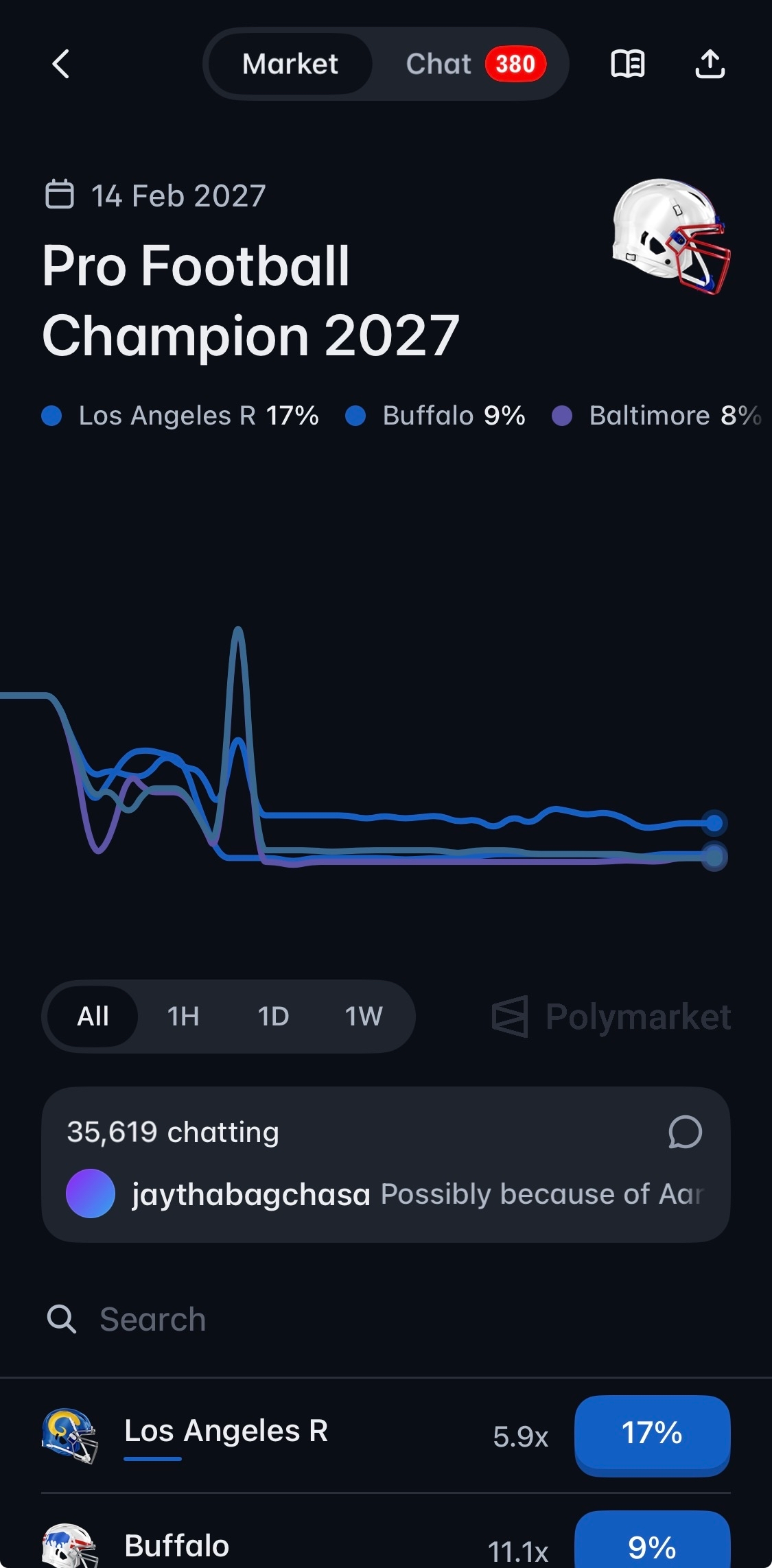
Polymarket’s current U.S. experience is a seamless, mobile-first ecosystem. While many legacy users associate the brand solely with its international desktop site, the dedicated U.S. app is where the modern trading experience lives. The waitlist is gone, so eligible users in 41 states and DC can download the app and start trading right away.
To maximize this mobile experience, simply input the Polymarket promo code
In our own testing, Polymarket US lived up to the mobile-first pitch. Account setup took about five minutes through an Apple login, funding with Apple Pay was instant, and the GRINDERS welcome bonus posted immediately.
We put $5 on the Cubs to win at 55¢ — the order filled instantly on the phone, and after Chicago’s walk-off, the contract settled at $1.00 for a winning trade. Cashing out to a debit card, the funds cleared in about a business day, faster than the three-to-four days the app estimated. One note: the U.S. app launched with a thin menu, but it’s expanded to a much wider range of markets over the summer.
What Are Kalshi’s and Polymarket’s Trading Fees?
Kalshi charges a per-contract fee that peaks on contracts priced near 50¢; Polymarket US charges a similar but slightly lower per-contract fee, while its geoblocked global exchange uses higher category rates.
Kalshi’s fees work like a futures exchange: because its contracts are standardized, the cost is predictable, and liquidity stays consistent for retail and institutional traders alike.
Polymarket actually runs two platforms with two different fee schedules. Its original global exchange, which is geoblocked in the U.S., uses category-based taker fees that peak near 50¢ (roughly 0.75% on sports, 1.00% on finance, politics, and tech, and up to 1.80% on crypto).
The platform U.S. traders actually use, Polymarket US, has its own schedule: a per-contract taker fee on the same curve shape as Kalshi’s but at a lower coefficient, plus a maker rebate for resting limit orders. In practice, that works out to roughly $1.50 per 100 contracts at the 50¢ peak against Kalshi’s $1.75; about 14% cheaper on the taker side, and where Kalshi charges makers a reduced fee, Polymarket pays them a rebate. Rates have been revised more than once in 2026, so confirm the current figures before committing size.
In short, fees are one area where Kalshi still feels easier to read at a glance.
In our own testing on Kalshi, a 10-contract market order on a liquid MLB game filled instantly at the 58¢ ask, while a quieter mid-week market showed a 6¢ spread where a market order would have made us eat the premium — a good reminder to use limit orders on thin books.
Polymarket looked tight too: across a couple of MLB games we checked on game day, the two sides of each market added up to about 101¢ — only a penny over fair value to cover both outcomes — a sign of liquid, efficiently priced markets.
Fee details last confirmed against each platform’s published schedule on 18th October 2026.
Hottest Prediction Market on Kalshi and Polymarket
Both platforms continuously showcase high-volume prediction topics across finance, sports, and politics:
- Kalshi: Vetted contracts like 2026 Midterm Congressional control, Federal Reserve interest rate moves, and daily MLB games.
- Polymarket: Dynamic markets like single-game live sports outcomes, crypto price milestones, and breaking tech or geopolitical news events.
While both deal with high-interest events, Kalshi’s listings come with formal vetting and approved election contracts, while Polymarket’s remain freer and more speculative.
Which Prediction Market Platform Fits You?
For most active U.S. traders, the move is to keep both accounts and trade wherever the market you want is priced better.
If you’re a U.S.-based user comparing these two giants, Kalshi offers a federally regulated framework that appeals to traders who prioritize standard U.S. banking methods, heavily vetted contracts, and a product that feels like a traditional stock brokerage.
Polymarket US, by contrast, is now open to eligible U.S. users with no waitlist. If you prefer faster-moving markets, a crypto-forward brand, and the dynamic price action that follows major global news cycles, Polymarket is a strong option. Its return to the U.S. market via QCX LLC gives it a solid regulatory foothold, letting everyday Americans trade into deep, fast-moving order books.
Both are strong; most traders should hold both and route each trade to whichever platform has the better price on the market you want.
Trading Responsibly on Kalshi and Polymarket
Event contracts are real money, and each one can settle at zero. Set a budget before your first trade, not after a losing one, and treat a welcome bonus as a way to learn the platform rather than a bankroll. One thing specific to prediction markets: if you’ve self-excluded from sportsbooks in your state, that doesn’t carry over.
State self-exclusion covers state-licensed operators, and both of these are federally registered, so they sit outside those programs. Kalshi offers account-level deposit limits, trading breaks, and self-exclusion; check Polymarket US’s account settings for the tools available there. If trading stops feeling like a choice, the National Council on Problem Gambling runs its National Problem Gambling Helpline at 1-800-MY-RESET, 24/7 by call or text, and 1-800-GAMBLER remains in service
Kalshi vs Polymarket FAQs
Below are some frequently asked questions pertaining to Kalshi, Polymarket and Kalshi vs. Polymarket, including their similarities and differences.
What are prediction markets?
Prediction markets allow users to trade contracts based on the outcomes of real-world events. Prices reflect the collective probability of those outcomes happening.
Is Kalshi legal in the United States?
Yes. Kalshi operates under CFTC oversight as a designated exchange — as does Polymarket US (via QCX LLC). Neither is available in AZ, IL, MA, MD, MI, MT, NV, OH, and WA.
Can U.S. users access Polymarket?
Yes. Polymarket’s U.S. platform is now fully open and accessible to eligible American users. You can easily download the mobile app and start trading immediately. To claim the best welcome bonus available upon sign-up, be sure to use the Polymarket promo code
What are election contracts?
These are markets tied to election results or electoral processes. Following landmark court victories in 2024 and 2025, both Kalshi and Polymarket (via its U.S. exchange, Polymarket US) now offer these as federally regulated “event contracts” for the 2026 Midterms and 2028 Presidential race.
How does Polymarket use blockchain?
Polymarket’s international platform relies on Ethereum-based smart contracts to record trades and automate settlement. The U.S. app works differently: trades clear through Polymarket Clearing, a CFTC-registered clearinghouse, with dollar-denominated balances, standard login and identity verification. Same brand, different plumbing.
Is there a risk of market manipulation?
Both platforms use mechanisms to limit it. Kalshi’s oversight minimizes manipulation through regulation; Polymarket relies on transparency and liquidity to deter abuse.
Are prediction markets replacing traditional betting platforms?
They’re not replacing them, but they’re expanding the ways people interact with information. For users who enjoy strategy and data, prediction markets feel like the next evolution of speculation.
Which is better right now, Kalshi or Polymarket?
There’s no single winner — it depends on what you trade. Kalshi is the stronger pick for economic and political markets and for anyone who wants a desktop, bank-funded experience that feels like a stock brokerage. Polymarket US is better if you want a mobile-first app and faster-moving sports and crypto markets. Most active traders keep both and place each trade wherever the price is better.
Check out RotoGrinders reviews of other prediction markets like Polymarket & Kalshi: