
Risers and Fallers: Volume 17

I’m back for another week of reviewing the most interesting players from the past seven days, pairing advanced metrics and insights from my DFS projection system, THE BAT, with my scouting background to try to figure out what to make of some the week’s most active lot of ballplayers. Guys whose stock is going up, guys whose stock is going down, guys who are perpetually underpriced or overpriced, guys who are worth paying a premium for, or guys who are just interesting and warrant some analysis on.
Over the course of the season, this series has evolved a bit beyond individual players to tackle commonly held DFS truisms that aren’t necessarily true. Today I’m going to dive into a big one, one that I’m sure I’ll catch some flak about, but one that math guarantees I’m right about nonetheless.
JUST PLAIN OVERRATED
The Win on FanDuel
For most DFSers who play on FanDuel, their pitching decision revolves around one thing: how they can get a win. And on the surface, that makes sense. After all, you only get one pitcher on FanDuel, he contributes the most points of any position (on average), and a win is worth as much as four strikeouts (as many as most pitchers get in a whole game). Compare that to DraftKings, where you get two pitchers and a win is worth the same as just two strikeouts, and you see why the emphasis is there on FanDuel. It’s that kind of comparison, however, that leads people astray, because no matter where you’re playing, the math and probability don’t change.
The flawed logic that most people fall into is that they have to get a pitcher who is as big of a favorite as possible so they can get those 12 points for the win. They ignore three crucial facts:
1) A team that is a favorite is not guaranteed to win
2) A team win does not guarantee a win for the starting pitcher
3) A pitcher who is a smaller favorite or even an underdog is similarly not guaranteed to not get a win.
Still, the decision for most people seems to be binary. “Either I take a favorite and get 12 points or I wind up with 0 from a non-favorite.”
Wrong, wrong, wrong!
Of course this is an oversimplification; most people do generally realize that it’s not a 12 or 0 decision, but they highly overestimate the true gap. Let’s use an example. On Sunday, the team with the best chance of winning, according to both THE BAT and Las Vegas, was the Washington Nationals. Vegas had them at -240, and THE BAT gave them a 66% chance of winning. Because Tanner Roark is mediocre and less likely to be credited with a W in any eventual team win than a legitimately good pitcher would, THE BAT gave him a 54% chance of getting the win himself, third highest of the day (behind Chris Sale and Johnny Cueto, whose teams were less likely to win but who would be more likely to get a W in any games they do win). The pitcher with the worst chance of getting a W was Roark’s opponent,
Tyrell Jenkins, at 16%.
You know what this means? Even a big favorite like Roark is not guaranteed for 12 points. His average win expectation was 6.48 points (12 points x 54% chance). That’s nearly half of the 12 points everyone goes on and on about. Jenkins would be expected for 1.92 points, or a marginal difference of about 4.5 points. Otherwise stated: the difference between the biggest favorite of the day and the biggest underdog was about 1.5 strikeouts. That’s a far cry from the “four strikeouts per win” rule that people reference. And this is using the biggest underdog of the day as the example. No one in their right mind would ever actually use Jenkins. With a pitcher who is in a good matchup and a smaller favorite, the gap would be obviously be much smaller, well under a single strikeout. In graphical form:

Now I don’t think Roark himself was especially popular on Sunday, but there are plenty of days where people will try to chase that win on FanDuel by picking a lesser pitcher simply because he’s a favorite, foregoing a better pitcher in a better matchup. Yes, in the real world, outcomes are binary, and it will suck to occasionally get a zero while the donkeys who play the biggest favorite get 12, but if you’re serious about DFS, you’re in it for the long haul. And from a strict probability standpoint, chasing the win at the expense of a superior pitcher is a terrible, inexcusable move.
If instead of listing 12 points for a Win FanDuel told people that the value of a marginal win was 2 points, who would actually care that much about the win anymore? Don’t get wrapped up in that big “12” number, because the real number is much smaller.
The final takeaway is this: Pitchers with a strong chance of winning the game will be slightly stronger plays on FanDuel than DraftKings, but they aren’t nearly as strong or necessary as most believe them to be. The difference between a merely above-average pitcher who is a strong favorite and an above-average pitcher in a pick ‘em game can be less than a single strikeout. If the pick ‘em pitcher has even a slightly better matchup, or if he’s a better pitcher in general, he is the guy you should be playing on FanDuel. Of course you should be taking everything a pitcher may contribute into account, but the evidence is so overwhelmingly strong that you could make the case that you shouldn’t care at all about who the favorite is on a bare bones level. If you need to simplify things as much as possible, down to a single rule, down to the level that inspired this whole analysis, you would be more successful by making this change in your FanDuel Rule of Thumb:
The Old FanDuel Rule of Thumb: Play a pitcher who is a big favorite
A Better FanDuel Rule of Thumb: Play a pitcher in a strong matchup for run prevention and strikeouts, regardless of how big of a favorite he is
FALLING… AND UNDERRATED
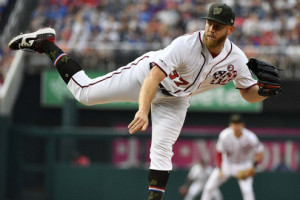
Stephen Strasburg in the Heat
On Friday night, Stephen Strasburg played the Atlanta Braves in 93 degree heat… and got obliterated. This led the Narrative Street sector of the DFS world to crow about how it was so obvious he would struggle because Strasburg hates pitching in the heat. But guess what? Everyone hates pitching in the heat! Offense goes up because air molecules are further apart, the air becomes less dense, less friction is applied to a ball in the air, and the ball goes further. High heat equals more runs. Moreover, heat sucks. It’s hot!
So where did this narrative come from? I’m guessing it had something to do with this story from 2011:
Washington Nationals manager Davey Johnson knew his dehydrated ace would not make another pitch after the third inning. Strasburg, after taking three intravenous treatments, was wise to agree… “Pretty scary, and he wasn’t talking too good,” Johnson said. “I found out later he got a little dizzy out on the mound. The problem was that he was totally dehydrated. I think the doctor gave him, you know, three transfusions of saline, and he still wasn’t going to the bathroom.” The Nationals announced during the fifth inning that Strasburg had left the game because of “heat-related issues.”
Of course, it was 106 degrees that day, so how indicative is that really of Stras on a 93-degree day? Strasburg has apparently said that he hates the heat. But just because Strasburg is vocal about it doesn’t mean that other pitchers don’t feel that way too and just suck it up. Some have said that Strasburg visibly sweats in the heat, but again, I mean, who doesn’t?
So what do the numbers say? And when looking at them, the important thing to keep in mind is that the question isn’t whether Strasburg is worse in the heat. The question is whether he’s significantly worse than we’d expect any other pitcher to be in the heat, and the clear answer before Friday’s game was NO.
This is the table I posted on Twitter, which shows how Strasburg is a bit worse in heat, but only about 0.50 points of ERA worse, which is not abnormal at all for a pitcher in 90-degree temperatures. This is especially true when you consider that, at this time of year, almost every pitcher is pitching in heat and taking a hit like this (outside of the stadiums with roofs and games on the West Coast that tend to be cooler).

This table doesn’t include Friday’s game, which would bump the “90+ degree” line up to a 3.99 ERA and 2.60 xFIP. That’s a big jump, but it’s still not anywhere near significant enough to consider fading Strasburg on hot days, especially when you consider that the sample is relatively small and that his peripherals have actually been better in the heat. In all likelihood, both are simply noise.
When I posted this on Twitter, I got into a long discussion with Tommy G (who was leading the “Strasburg struggles in heat” bus) about it, and he suggested that perhaps Strasburg struggles more on days with an extreme heat index (i.e. a bad combination of heat and humidity where pitchers really feel the heat). The problem here is that the sample size gets very small. On days with a heat index above 100 (which is considered the extreme caution zone), Strasburg had pitched in just four games with a 3.80 ERA prior to Friday. It goes up above 4.00 when you consider Friday, but just five games is really tough to make any sort of concrete judgment on.
Perhaps it’s something to keep in mind on the very rare days Strasburg has to deal with another 100+ degree heat index, but it’s unlikely to be something I’ll fade him for if he’s otherwise the clear play once you account for the matchup and the normal effect of heat and humidity on pitchers (which THE BAT does account for). His next two matchups are in Colorado and in Baltimore, so he’s unlikely to be an option in either, but I’ll be curious to see how much steam this narrative picks up on the next hot day Stras is in a good matchup.