
Lars and the Real DFS Problem


Ever been to a Double-A baseball game?
It’s not the most glamorous setting. Sure, it’s still baseball – professional baseball, in fact. The guys are still getting paid to play, and the fans are still buying hot dogs and drinking beer. The grass is still green (though not quite as impossibly green as it is in the Majors), and a bat is still a bat, and a ball is still a ball. Those things are the same.
But really, nothing is the same. The fans are not really there to watch the games. The ballparks are usually not all that nice, and most of the guys are being paid far less to play each day than those in the stands make at their jobs. These players take long bus rides to games. They eat stale food. They often live in host homes. No wonder they’re so desperate to make it to The Show.
There are some guys who are ticketed for the Big Leagues from the start, and such guys live off their massive signing bonus as they shoot through the Minors – getting only a taste of what the Minor League life is really like. But others spend years as “organizational depth” – being paid, truly, in order to simply provide competition for top prospects – to act as a facilitator for the development of these prospects while these “organizational depth” players themselves continue chasing that dream that maybe, someday, they can crack a Major League roster.
Of course, some situations in the Minors are better than others. As far as Minor League situations go, one could do a whole lot worse than playing for the Tulsa Drillers (current Double-A affiliate of the Dodgers; former affiliate of the Rockies and the Rangers). The Drillers play in a beautiful new ballpark in a cool part of a cool little city. They’ve had players such as Pudge Rodriguez and Sammy Sosa and Matt Holliday pass through their system. And anyway – hopefully you’re not there for long, right? Hopefully, you’re only with the Drillers for a few months before moving up to Triple-A, then moving up to the Bigs.
But, of course, that’s not always the case.
That’s not the case, for instance, for Lars Anderson.

As most of you know, I grew up in Boston and have been a Red Sox fan all my life. Lars Anderson was once a top prospect of the Red Sox. In 2009, in fact, he was ranked by both Baseball Prospectus and Baseball America as the number 17 prospect in all of baseball. That was a good year for prospects; Matt Wieters, David Price, Jason Heyward, and Madison Bumgarner sat atop the prospect ladder, but Lars was in pretty good company back at number 17 as well. Baseball America’s list, for example, looked like this: #14 – Buster Posey; #15 – Dexter Fowler; #16 – Giancarlo Stanton; #17 – Lars Anderson.
Yeah. As Sox fans, we were pretty excited about the kid. He even cracked the Big League roster for a bit in 2010, and again in 2011 and 2012.
So when a buddy texted me the other day to say, “Did you know Lars Anderson is now playing for the Tulsa Drillers?” it reminded me of just how crazy it is that he is languishing in Double-A ball.
How does this happen? Well, if there were an easy answer, I’m sure Lars himself would have figured it out already. Right?
But I hope you haven’t given this article up as a bad job – as something that has “nothing to do with daily fantasy sports” – because I promise you that this is tying in. And I promise that this information about Lars is relevant to what I’m coming around to.
You see, there are different reasons why different prospects fail to reach their ceiling. Sometimes, it’s because a guy was overrated from the start. Sometimes, it’s because a guy had injury problems. Sometimes, it’s because a guy simply did not work hard enough.
What was the case, then, with Lars Anderson? How did a guy who was hanging out in 2009 on prospect lists with names like Buster Posey and Giancarlo Stanton end up still playing Double-A ball in 2015?
For the answer, we will look to another former Tulsa Driller (and former member of the Red Sox), Gabe Kapler.
Gabe Kapler – now a member of the media, and a pretty smart guy with some pretty interesting thoughts/takes on the world of baseball – was Lars’ manager for a year at Single-A Greenville. Two years ago, when Lars Anderson had been released by the Triple-A Charlotte Knights, Kapler wrote an extremely insightful piece for WEEI (the premier sports radio station in Boston). In that article, he talked about Lars as he knew him. Sure, he talked about the kid’s baseball prowess – saying he may have been the best pure hitter on that 2009 “top prospects list” – but he also talked about Lars as a human being. He talked about how Lars often asked questions relating to art, history, and music. He talked about how the two of them would discuss philosophy, how the two of them would discuss family history (going so far as to examine, together, the ways in which their respective family histories had shaped them both emotionally and intellectually). He talked about how Lars was “astonishingly hard on himself.”
In the article, he told a story about when Lars had been drafted by the Red Sox, and was taking live batting practice against Keith Foulke and David Wells. At the time, Kapler was still on the Red Sox, and the way he remembered that day, both he and the pitchers were surprised and impressed at all the hard contact being made by this 18-year-old kid. The way Lars himself remembered it? He remembered being upset that he kept pounding the ball into the ground and having a hard time getting the ball in the air for hard line drives or home runs.
Of course, when channeled correctly, this attitude and outlook can have a positive impact on an athlete. It can drive an athlete to become better. But by the time Kapler became the manager of Single-A Greenville, that wasn’t what he saw. Instead, he saw a guy who was so hard on himself, it prevented him from ever really being able to get outside of his own head.
Perhaps you see where we are going with this now…
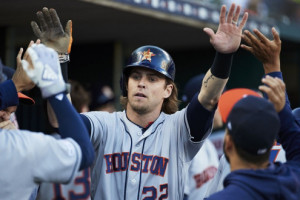
In the article, Kapler talked about Josh Reddick’s approach at the plate (Reddick batted next to Anderson in the batting order at Greenville that year) – how Reddick would identify any pitch he liked (which was, pretty much, any pitch near the strike zone), and would swing as hard as he could. His mentality was that no one would beat him… and if they did, he would get them next time.
Kapler related Reddick’s approach at the plate to a time when he was playing with Pudge Rodriguez in Texas, and Pudge crushed a home run. When he returned to the dugout, Kapler – in an effort to gain information for his next at bat – asked Pudge what kind of pitch he’d hit out. Pudge’s answer? “I don’t know.”
Kapler went on to say that he often wonders what a hitter like that could do if they incorporated analytics and as much information as they could gather into their approach at the plate. And then…
He said: “Alternatively and equally as fascinating is the notion of how good a guy like Lars could be without the burden of analytical thought.”
And this, my friend, is exactly the way I sometimes feel about daily fantasy sports.
Recently – coming off what was probably my best four-week stretch in my MLB DFS career (a stretch during which “failing to cash in the top 5% of tournaments” was considered a disappointing night) – I went through a two-week cold stretch in which I could barely cash in anything. If I played tournaments, I would finish one or two points out of the money. If I played double-ups, I would finish one or two points out of the money. But the worst part of all was this: I knew it wasn’t “just variance.” I knew, instead, that I was changing my approach in small, subtle ways… and that I was entirely unable to identify what these “small, subtle ways” might be. I had nights on which I narrowed down my options to 18 hitters… and on which the eight hitters I used combined for five or six hits and one home run, while the 10 guys I discarded combined for 15 or 16 hits and five or six home runs. I had nights on which things came together with my bats, but my pitchers fell apart. I had probably three different nights on which I made a last-minute switch that led to me not cashing… but then, I had probably another three nights on which I decided against making a last-minute switch and would have cashed if I had made it.
In short, I was a mess. I knew I was screwing up fundamentally, in the core of my approach… and yet, I was entirely unable to identify exactly where I was messing up.
And then, I was in Boston visiting my parents. I woke up on Saturday morning and decided to enter a team in the early slate. I had very little time to do research (no time to do research, really), but I spent about 20 minutes acquainting myself with the slate – not looking up anything or researching at all, but instead simply spending a bit of time assessing things based off what I already know about all the players across Major League Baseball – and I threw together my team.
Can you guess what happened? Yeah. I had my best day in over a week.
I hadn’t planned to play the late slate that day, but as I watched Scherzer’s no-hitter and worked on my “Stop Wearing DFS Reebok” article, I realized I had enough time to throw together a team for the night slate as well. So I did. Again – no research; just piecing things together off of what I already know.
And again, I had a great slate – no problem at all. It felt just as easy and obvious as things had felt during my tremendous four-week stretch.
And this is what I realized: Sometimes, our biggest obstacle to DFS success is our own self. Sometimes, our mind – our tendency to overthink things, and our propensity to second-guess our original instincts at every turn – is the greatest enemy we have.
Sometimes, we need to be less like Lars Anderson and more like Josh Reddick. After all, one of them is in Double-A, and the other is often too expensive to comfortably fit into our DFS rosters.
Or better yet: sometimes, we need to find the hybrid between these two guys. Sometimes, we need to find the approach that incorporates “analytical thought,” while also learning to get outside our own mind enough to let our knowledge, instinct, and DFS skill take over when we “step up to the plate,” so to speak – when we sit down to build the roster that we expect to carry us into the money.

When my buddy texted me about Lars Anderson being with Double-A Tulsa, I told him about the article Kapler had written, and how it seemed Lars’ real problem was that he was just too smart, and just too unable to get outside of his own head. We talked about how crazy it is that this can happen in baseball, and I brought up that stretch when Jarrod Saltalamacchia could no longer throw the ball back to the pitcher, and how Daniel Bard went from being the best setup man in baseball to being completely unable to throw strikes at all. I then said: “A guy needs to be a Manny Ramirez type to avoid those downturns – someone who works his tail off, but is also generally a complete idiot.”
My buddy then said it even better: “Exactly. Someone fully, mentally inept at understanding anything outside muscle memory with crazy drive who wants it.”
During NFL season, I talk a lot about how my “research” is rarely slate-specific – how I, instead, make an effort to know the NFL as well as anyone, and to then use the knowledge I already have to help me build my NFL DFS rosters.
In MLB, I am working to reach that same place.
Honestly, I already know Major League Baseball as intimately as I know the NFL. I know the players, the matchups, the advanced stats, and how it all ties together. But when I enter a cold streak, I become like Lars Anderson – thinking through everything at the plate instead of allowing my knowledge to take over.
And I’ll tell you this: I know that I am certainly not the only person who has ever felt this way.
If you have ever had a night in DFS where you looked back at the conclusion of the slate and recognized all the mistakes you made – and spotted all the players you moved away from that performed so much better than the guys you used (and that, in retrospect, were such obviously superior plays as well) – this is for you.
If you have ever labored over your lineup for hours, tinkering and tinkering because things just aren’t quite good enough, this is for you.
If you have ever found yourself changing your roster right up until games begin – not because you haven’t yet finished your roster, but instead because you can never quite “be done building your roster” and seem to always keep changing things right up until first pitch – this is for you.
If you have ever second-guessed yourself right out of the money, this is for you.
If you have analyzed your teams to a point of paralysis, it’s time for you to stop.
Listen: work hard at DFS. You can luck into a few wins here and there, but the only way to be consistently successful is to understand the sport you are playing – know the players, know the stats, know the game. Spend time learning. Spend time studying. Spend time improving your knowledge until you reach a point where you can say you know the sport as well as anyone. Become the MLB DFS equivalent of Manny Ramirez – who, for all his strangeness and antics, was widely regarded as one of the hardest-working players in all of Major League Baseball.
And then, when you step up to the plate, leave your Lars in the dugout, and become like Manny there as well. You’ve worked hard. You know your stuff. You don’t have to overthink things and second-guess yourself and labor until you’ve pushed your team right out of the money. All you have to do is get up there and swing – build your team – and let the hard work you have put in carry you to success.
It may not be easy to do – but really, it might very well be just that simple.