
Risers and Fallers: Volume 1

My first article at RotoGrinders! For those who don’t know me yet, I’m Derek Carty. You may have read my articles at ESPN.com, seen me on Baseball Tonight last year, at Fantasy Insiders the past couple years, or on GrindersLive in the opening days of this season, or you may be a subscriber to my projection system, THE BAT.
Each week I’ll be here to review interesting players from the past seven days. Guys whose stock is going up, guys whose stock is going down, guys who are perpetually underpriced or overpriced, guys who are worth paying a premium for, or guys who are just interesting and warrant some analysis on. If anyone ever has a suggestion for a player they’d like to see included, feel free to send me an email or a tweet.
Without further ado, let’s jump right into it!
RISERS
Trevor Story, SS, Colorado Rockies
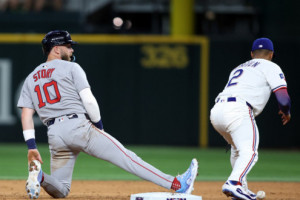
Story has cooled considerably since his scorching start to the season (how was he not going to?), but he continues to hit well. His price rose as high as $4,700 on FanDuel and $5,000 on DraftKings in the most recent Coors series after starting the year at $2,500 and $3,400, respectively. This, of course, creates the question of whether he’s worth it. You may not have heard of Story before this year if you’re not up on your prospects, but he comes with a high pedigree and is a legitimately good hitter. Even before accounting for his scorching start to the season, THE BAT would think him the best shortstop of the day in most Coors slates. So, yes, he’s expensive in Coors, but he’s also a shortstop and a very talented one at that. I have no problem paying up for him when the matchup is right.
One thing to keep in mind: some have voiced concerns that he struggles with the cutter, so I may consider that when deciding whether to play him against a particular pitcher, but I wouldn’t let it rule my decision or dissuade me if he’s in an otherwise good spot.
The Dodgers come to town at the end of the week, and I imagine I’ll be playing Story.
Juan Nicasio, SP, Pittsburgh Pirates
Despite a dominating first outing, Nicasio’s price remained low for his second start today at $6,100 on DraftKings and $7,400 on FanDuel. Nicasio has had his share of struggles over the years, many of which related to injuries (and being a Coors pitcher didn’t help any), but he was once thought to have solid potential. His stuff is certainly intriguing, featuring a 95-mph fastball and a plus slider. It’s usually unwise to put much stock into Spring Training stats, but they’re worth noting for Nicasio because of how incredible they were and because of how Pirates pitching coach Ray Searage tends to turn reclamation projects like Nicasio into fantasy gold.
Even without projecting a big boost from Searage (since that’s hard to quantify), Nicasio would still project as a worthwhile pitcher in most matchups, in part because of his favorable contextual factors. PNC Park is one of the best in baseball for pitchers, and Francisco Cervelli and Chris Stewart are both great pitch-framers. Nicasio’s lack of a good third pitch may make him susceptible to left-handers, but while he remains this price he’ll often be a quality second starter option on DraftKings. He’ll be in Chase Field next weekend so won’t be an option then, but struggling through that start should continue to keep his price low for when the next exploitable matchup comes along.
Colby Rasmus, OF, Houston Astros
Rasmus has been ranked as a top outfield option several times this year by THE BAT, and all he’s done is hit. His price, however, has yet to go above $4,000 on DraftKings, reaching $3,900 but sliding back to $3,600 today. He has a big true platoon split (over a 50 points difference between his true wOBA vs. LHP and vs. RHP) and bats cleanup for one of the best offenses in baseball. Most don’t really see Rasmus as an elite outfielder after years of mediocrity, but on days when he’s at home in hitter-friendly Minute Maid against even an average righty, he’ll continue to be a top outfield option and one that is close to a must play while his price remains at this level. The Astros face a couple lefties in Texas this week, so Rasmus will be out of play, but they’ll return home to face the Red Sox later in the week.
Carlos Correa, SS, Houston Astros
This one is less about Correa himself and more about how he’s indirectly affected by changing circumstances this week. A couple days ago, DraftKings decided to give Manny Machado shortstop eligibility, leading some to call him a must play most days. While Machado is a great hitter and will certainly be used by me in the right matchups, I think this bodes well for Correa. Creating a decision at the top price point at shortstop that wouldn’t otherwise have been there (excepting Coors days when Trevor Story would be in the mix) is ultimately a good thing for those who have the ability to distinguish two options that appear to be equally great. For me, I’m envisioning Correa’s ownership levels to decrease as a result of this, which is a good thing considering 1) he’s the more talented of the two (not by a lot, but it’s there), and 2) he has the better surrounding offense. I imagine he’ll project slightly higher than Machado most days, and that should lead to gained edge.
Nomar Mazara, OF, Texas Rangers
With Shin-Soo Choo hitting the DL, heralded prospect Nomar Mazara was called up from the minors a week ago and installed as Texas’s number two hitter. Since then, he’s accumulated an absurd .431 wOBA while consistently turning a profit for those who draft him. Mazara is a rare prospect who has both a high floor and a high ceiling, and he’s basically at that floor now. Additionally, both his hit and power tools are plus, giving him multiple ways to contribute to a fantasy team. He’s pretty much been a must play since being called up given a price tag that hasn’t fluctuated much, ranging from a low of $2,900 to a high of $3,300 on DraftKings. Mazara’s bat is (obviously) big league ready right now, and until DraftKings’ pricing reflects this, he’ll continue to be a huge bargain. The Rangers start this week facing some weak Houston righties and then head to U.S. Cellular, so it’s looking like another good week for Mazara.
Jeremy Hazelbaker, OF, St. Louis Cardinals
Hazelbaker does not have the pedigree of a Story or Mazara, truly coming out of nowhere, but he’s been raking nonetheless. Like Mazara, his team has decided to hit him second against right-handers. He doesn’t have the same talent as Mazara or the same quality of surrounding offense, and his price is a bit higher, but it’s still in very reasonable territory. Most are wondering if Hazelbaker is legit, and the simple answer is yes. He’s obviously not .513 wOBA legit, but he’s a legitimate major league hitter. His 36 percent hard contact rate is impressive, and at a minimum we should be considering him a league average hitter with an above average platoon split. There aren’t a lot of great matchups for the Cards this week, so it’ll be interesting to see how Hazelbaker fares and where his price winds up by the end of the week.
FALLERS
Miguel Sano, 3B/OF, Minnesota Twins
When Sano is a right, he’s one of the most valuable DFS players in the game. He has true 80-grade power and can put up big points in a hurry. For the first two weeks of the season, though, Sano has been anything but right. He’s clearly struggling at the plate, and it’s evident not only in his .143 batting average and zero home runs, but in his peripheral stats as well. He’ll always strike out a lot, but the rise in his K% from 35% to 40% is one red flag. Another is his drop in hard hit percentage from 43% (an elite mark) to 28% (a below-average mark). Finally, he’s hitting more flyballs the opposite way this year (57% compared to 43% last year), which is generally a sign of not squaring the ball up well. Power hitters generally want to pull the ball or hit it to center field, where Sano connected on 17 of his 18 dingers last season.
There’s clearly something different about his approach and/or how pitchers are approaching him, and until he makes the necessary adjustments he’s going to be a tough guy to play in anything other than a GPP—though his rapidly dropping price tag will make him tempting any time he’s in half-way decent matchup. For me, he’s getting the “exclude” treatment in Lineup Builder until he starts to hit. I’m okay missing that first, big, inevitable game.
Daniel Murphy, 2B/3B, Washington Nationals
While there are still many DFS players who largely ignore a player’s place in the batting order, most of the savvy ones now consider it to some degree. A pretty popular rule, and one that I’ve advocated for years, is not to play anyone outside the top five of the order in cash games (with certain small slate, Coors, or minimum price exceptions). This seems to have caught on, but maybe a little too much. You see, just because you want a guy in the top five doesn’t mean all spots in the top five are created equal. The fifth spot is easily the worst, which makes sense when you rephrase the rule: the fifth spot in the order is the cutoff point, the last acceptable spot at which you can reasonably play a hitter in cash games. As in, it’s just better a bit than sixth, which the rule says is unacceptable. Now the point of this isn’t to convince you that you should consider sixth-place hitters, but rather than hitting fifth isn’t as advantageous as most seem to think.
The Washington Nationals have two players that hit in the top five and qualify at both second and third base. One has a career .330 wOBA. The other has a career .336 wOBA. The one that’s the better hitter bats second in the order. They are similarly priced. Yet somehow, the lesser hitter in the lesser lineup position consistently goes much higher owned. Murphy has been raking this year, which likely has something to do with it, but even before that bias was established, he was still more popular in the early days of the season. Murphy also has the platoon advantage on days Rendon doesn’t, but THE BAT only projects his wOBA vs. RHP to be 5 points better than Rendon’s, rendering the platoon advantage fairly moot—and highlighting that Murphy is due to regress from his hot start.
The difference between second and fifth is an extra third of a plate appearance per game and 34% more RBI and run opportunities. For me, for the $4,000-plus price tag on DraftKings, I’ll take Rendon over Murphy every time… and several other players at the position as well.