RotoAcademy Preview: Split Ends

Splits. They come in many different forms: home or away, day vs. night, vs. left or vs. right, in a box vs. with a fox, you name it.
Split stats can reveal some shocking tendencies that put player performance in perspective, but they bring plenty of caveats to the table. The smart DFS player is cognizant of splits and uses them to his/her advantage, but the wise DFS player also recognizes the limitations, and will not go blindly into the night’s slate. Split stats are naturally limited by sample size, as we slice and dice a player’s performance record to tease out specific situations. It can take years for split stats to stabilize to a level where they can be trusted, and by that time the player in question is likely to have changed significantly, rendering moot the splits of his youth.
Editor’s Note: This is one of the many valuable DFS lessons that can be found over at RotoAcademy. Click here to browse through all of our free/premium offerings and improve as a daily fantasy sports player!
In this sense, split stats can be misleading and encourage a false sense of security. A great way to reap the full advantage of splits is to stockpile them in a single direction, targeting players whose splits are relatively extreme and whose context further promotes the advantage. For example, Corey Dickerson had displayed an egregious divide for his platoon splits (he mashes right-handers but flails against lefties) as well as his home-road, being a typical Colorado killer who struggled at sea level. As a result, I would only use Dickerson when he was at home and he was facing a right-hander, rather than seeking his services in the case of either/or.
Another example is to stockpile splits between a hitter and pitcher, such as targeting Dickerson at home against a right-hander like Wily Peralta, whose own performance record includes a 106-point difference in career SLG that reflects his vulnerability to left-handed bats. The fact that Dickerson is 6-for-10 in his career against Peralta with a pair of bombs is merely icing on the cake.
Dickerson is now on Tampa Bay, so his specific case is moot for 2016, but the lesson still applies when using splits in DFS. They can provide an edge against the competition when used efficiently, sticking to the extreme ends of each split-spectrum and compounding the advantage by stacking them on both sides – the hitter as well as the opposing pitcher.
Let’s take a look at some of the more useful split-stats that are available to the analytical DFS gamer.
Platoons
Platoon splits carry intrinsic value at sites that don’t incorporate platoons into the salary structure (as was the case last year at DraftKings), and that value is high enough that I rarely seek out batters that don’t have the platoon advantage on a given day. There are few exceptions to the rule that batters hit opposite-handed pitchers better than they do like-sided arms, and every year we are reminded of this fact by the league-wide results.
MLB Platoon Splits, 2015
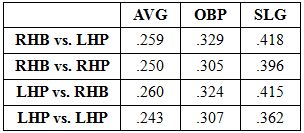
The takeaway here is that, from a platoon standpoint, the focus should be on left-handed pitchers. Every day, I make a quick list of southpaws that are slated to start in order to get an idea of the hitters that I should target (right-handed bats facing a soft left-hander) or avoid (lefty bats facing a tough southpaw). There are a few exceptions, but using this general strategy, I can narrow the player pool.
The other piece of the puzzle is to know which players at which positions have exceptional platoon splits. Sample-size caveats apply, but the stark contrast in the numbers versus left-handed pitchers and right-handers is enough to target certain players. Here is a list of examples (the stats for pitchers indicate what they have allowed):
Extreme Platoon Splits, Career
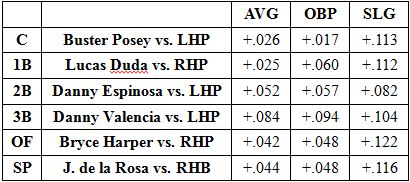
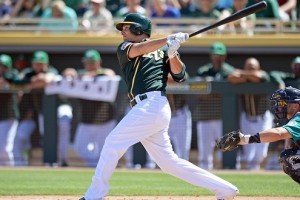
The above list is far from exhaustive, and most regular gamers already have some these players in their crosshairs – just watch what happens to the ownership rate the first time that Buster Posey faces a non-threatening lefty. Sometimes, the split is more about the batter’s failings versus same-side pitchers than it is domination with the platoon advantage (see Duda, Lucas). Combining the platoon trends of pitchers and hitters yields the best results, so if Posey is facing Jorge de la Rosa then the ownership rate will skyrocket (especially if the game’s in Colorado), and yet the splits are so well-stacked that I would roster him with impunity. It’s worth doing a little bit of homework to dig up these extreme splits, and I usually let the day’s slate dictate my research – a player like Valencia might be unearthed simply because the A’s are facing a light lefty and Valencia’s modest price tag happens to fit a roster’s budget.
Steals
Stolen bases are unlike any other stat in baseball, in the sense that they involve an element of choice that puts it under a player’s control. The decision of whether to steal often depends on the opposing pitcher-catcher tandem and their ability to stop the running game, so it is critical to spot the opportunities where a runner will be more enticed to run. Following the idea of stacking position-player strengths with pitcher weaknesses, I will generally target speed-first players when they are facing a pitcher who sees a lot of traffic on the basepaths.
Most SB Allowed, 2015
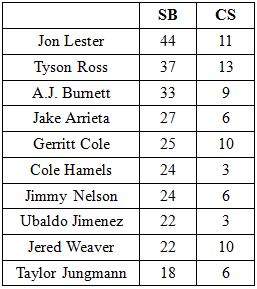
On June 14, Billy Hamilton stole five bases against the Chicago Cubs, part of a day that earned him 37 points on DraftKings and 14.75 points on FanDuel. He was also highly owned in DFS that day, largely because he was facing Jon Lester, whose notorious struggles with holding runners created a perfect opportunity for the base-thieving Hamilton. It was a stark reminder why speed-only players are best employed on days when the opposing pitcher creates opportunities.
There is an interesting mix of studs and duds on this list of pitchers. There might be a good opportunity to zig with a light-hitting speed guy against a tough pitcher such as Arrieta or Cole, as runs will be scarce (in theory) so base-stealers might be more likely to take off, plus the position player is likely discounted. Against the Weavers and Ubaldos of the world, a base stealer can be part of an overall stack with a lineup that figures to rack up the fantasy points against a weak pitcher.
In contrast, there are some pitchers who seem to close off the running lanes entirely:
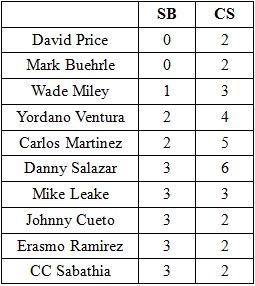
I will not roster speed-only players like Dee Gordon, Delino DeShields, or Billy Burns against one of the above pitchers, and I will also tend to avoid players with a wider swath of skills but whose impact on the bases makes up a large part of their value, such as Jose Altuve or Starling Marte. Odds are that I can find better use for the money left under the salary cap.
Home Runs
Just as there are batters that are more prone to hit the ball out of the yard, there are pitchers who are more prone to serve it up.
Highest HR Rate Allowed, 2015 (min. 162 IP)
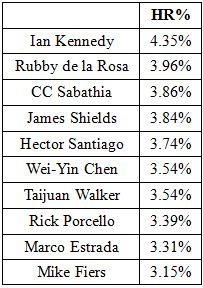
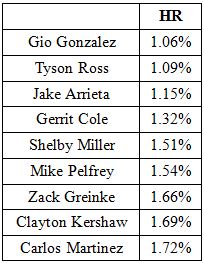
But be on the lookout when a slugger is up against one of the pitchers from the following list:
Lowest HR Rate Allowed, 2015 (min. 162 IP)
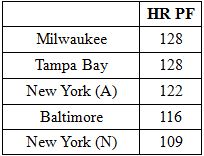
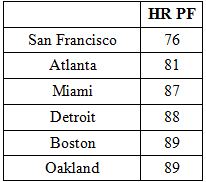
Ballpark dimensions also play a role in the game of predicting home runs, and different parks are more or less conducive to left- or right-handed hitters. Here are the ballpark factors for home runs to batters on each side of the plate; keep in mind that park factors are scaled to 100 being average, such that a park factor of 110 is 10 percent more friendly to home runs and a ballpark factor of 90 would be 10 percent tougher to hit home runs than the average park.
Highest Park Factors for Home Runs, LHB
Highest Park Factors for Home Runs, RHB
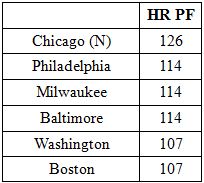
Keep in mind that the park factors at Wrigley Field tend to fluctuate wildly due to the ever-changing wind patterns. Knowing the wind conditions in Chicago is critical on a game-to-game basis, and Kevin Roth’s weather resource on RotoGrinders will indicate how hard and in which direction the wind is blowing for every Cubs home game of the season. Note that Milwaukee and Baltimore show up on both lists in the top four for home run park factor.
Lowest Park Factors for Home Runs, LHB
Lowest Park Factors for Home Runs, RHB
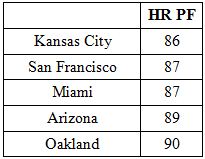
When it comes to squelching home runs, AT&T Park is king. The San Francisco ballpark’s expansive outfield and heavy sea-air make it a bad bet to pay for opposing sluggers when playing against the Giants, though it does bode well for pitchers. It was the toughest park in the game for left-handers and just missed being the harshest on right-handed bats. Marlins Park also ranked high on both lists, as did the Coliseum in Oakland, but in Miami they have adjusted the fences over the offseason and it remains to be seen what type of impact that will have.
In How to Go Against the Grain and Earn a Profit in MLB DFS you’ll learn:
• How each slate should dictate your approach and strategy
• How to deal with pitching on each slate, whether that day includes elite or average pitchers
• How to find edges with hitters to take your GPP lineup to the top
• Why splits provide one of the biggest edges in daily fantasy baseball
• Where to find resources to make your daily fantasy baseball research an easy one every day
To read the rest of ‘How to Go Against the Grain and Earn a Profit in MLB DFS’, you must purchase the course!