
NFL Millionaire Maker Ownership Review: Wild Card Round

Welcome to the Wild Card Round ownership breakdown of DraftKings’ Millionaire Maker during the wild card round. I analyzed the data of all DFSers who submitted 250+ lineups into the big GPP (pros) and compared them against the field, with the analysis focusing on players that were “make-or-break” options.
With over $5,000 at stake, what key players did the pros hone in on and which ones did they fade? The ownership percentages are displayed as an average between all the top players as well as the peak of a single pro’s lineups.
Quarterback
1. Aaron Rodgers $6,400, 18.30 points (17.9% owned)
Pros’ average ownership: 27.4 percent, Peak ownership: 51.0 percent
 Ar $6,400, Rodgers was the cheapest salary he had been all season, down from a peak of $8,600 to start the season. While he and his receivers had not been on the same page for the last few weeks, Rodgers had some of the most playoff experience and success on the slate (Hello Roethlisberger). We had seen the extent of his ceiling earlier in the season against even the stoutest of defenses: KC in Week 3 (37.92 DK points) and @CAR in Week 9 (36.96 DK points). Against a Redskins defense that was the worst on the slate and that had ranked #19 in pass DVOA, the Packers were projected to score the second-highest total of the weekend and only -0.75 points less than their season average (best differential of any team). Aaron Rodgers was looking to bounce back in a matchup that had the highest chance of a shoot-out on the weekend.
Running Back
1. Christine Michael $4,400, 9.4 points (28.0% owned)
Pros’ average ownership: 17.9 percent, Peak ownership: 45.9 percent
After undergoing a full set of practice reps on Wednesday, Thursday, and Friday with the 1st team, Marshawn Lynch was looking like a go. However, he did notified the team after practice on Friday that he didn’t feel like he could play and did not board the team bus to the airport on Saturday, leaving Christine Michael, Bryce Brown, and Fred Jackson to carry the workload. As Christine Michael was slated to start, the public jumped all over the chance to play the starting running back in Seattle’s white-hot offense at a comparatively bargain-basement price. However, the problem with starting Michael was his workload. Reports from Saturday pointed out that the backs would most likely see a split timeshare, which was corroborated by the snap counts from Michael’s last three starts (40%, 31%, 34%). Over that time period, he had just averaged 13 carries a game and scored zero touchdowns. While he had been averaging 4.92 YPC and would have made a decent cash-game play, his reduced workload would severely limit his chances at a high payoff.
2. Giovani Bernard $4,000, 4.0 points (12.2% owned)
Pros’ average ownership: 24.4 percent, Peak ownership: 51.0 percent
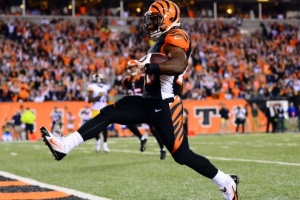 Gio hadn’t done much in recent memory to impress (averaging 7.7 DK points over his last six games), which may have been why the public was off of him, even at a season-low salary of $4,000. However, the Bengals were projected to lag throughout the game, which would lead to more usage from Gio in a higher percentage of pure passing downs. Over his last four games, Gio had averaged over four targets a game and was looking to see a few more against the Steelers. AJ McCarron would continue to lean on Gio during checkdowns, leading to a mediocre floor with plenty of upside.
Wide Receiver
1. Marvin Jones $3,700, 7.2 points (7.3% owned)
Pros’ average ownership: 14.3 percent, Peak ownership: 38.2 percent
Through McCarron’s four starts, Marvin Jones tied AJ Green with the most targets on the team at 25 (averaging 6.25 per game). At a price point of $3,700, Marvin was a cheap entry into the Bengals passing game that would most certainly be playing from behind. The Pittsburgh defense had been a middle of the road pass defense (#15 DVOA), which was the second-best matchup for what was a playoff slate. As Pittsburgh also ranked below average in catch rate (64%), YPA (8.5 yards), and ranked #26 for pass DVOA against deep balls, Marvin had potential to have another 20+ point game.
2. Jermaine Kearse $3,300, 4.8 points (6.5% owned)
Pros’ average ownership: 14.9 percent, Peak ownership: 42.8 percent
With Marshawn Lynch declared inactive prior to kick-off, you could almost hear the mouse clicking of everyone editing their lineups to get a piece of Seattle’s passing offense. Sure the temperature prior to kick-off was projected to be under 0°F (~ -20°F with wind-chill), but that would not stop the inferno that was Russell Wilson. I don’t need to remind you of his stats since Seattle’s bye week, but know that Doug Baldwin, his favorite target, would be matched up against one of the NFL’s best slot corners in Captain Munnerlyn. With Minnesota more susceptible to the deep ball, Kearse had been a viable option to contribute. He had averaged five targets per game over his last four games and would matchup with Xavier Rhodes, who was required to wear boxing gloves at practice earlier in season to teach him not to hold.
Tight End
1. Travis Kelce $4,500, 23.8 points (11.9% owned)
Pros’ average ownership: 24.9 percent, Peak ownership: 71.0 percent
 Outside of Jordan Reed and Tyler Eifert, Kelce was the only other tight end who had significant upside and came out as the cheapest of the three. Kelce had put up six catches for 106 yards and two touchdowns in Week 1 against the Texans. Although the Texans defense had greatly improved since Week 1, Kelce and Jeremy Maclin would make up much of Kansas City’s production through the air. Kelce’s low salary helped open space in the roster for a mix of the top WR options available on the board: Antonio Brown, DeAndre Hopkins, AJ Green.
Defense & Special Teams
1. Washington Redskins $3,300, 1.0 point (7.6% owned)
Pros’ average ownership: 4.2 percent, Peak ownership: 16.0 percent
As the Packers had capped off the regular season losing by 30 to the Arizona Cardinals (Arizona D: 33 points) on the road and by seven at home to the Vikings (Minnesota D: 19 points), it was an easy momentum play to pick the Redskins against them. However, the Redskins defense was not at the same level as each of those teams. The Redskins allowed 24.2 points per game during the regular season and were ranked #19 in pass DVOA and #22 in rush DVOA. Vegas had projected the Packers to score around their season average in what was essentially a pick’em game (even odds) depending on which site you viewed. Although it was not a bad play, there was not any additional incentive such as the weather to play the Redskins over any other defense and the pros found better value elsewhere.