
Risers and Fallers: Volume 10

I’m back for another week of reviewing the most interesting players from the past seven days, pairing advanced metrics and insights from my DFS projection system, THE BAT, with my scouting background to try to figure out what to make of some the week’s most active lot of ballplayers. Guys whose stock is going up, guys whose stock is going down, guys who are perpetually underpriced or overpriced, guys who are worth paying a premium for, or guys who are just interesting and warrant some analysis on.
If anyone ever has a suggestion for a player they’d like to see included, feel free to send me an email or a tweet.
Without further ado, let’s jump right into it!
RISING… BUT I’M NOT BUYING
Franklin Gutierrez, OF, Seattle Mariners
Gutierrez is coming off a terrific series in Fenway, having slugged two homers on Friday (putting up 40 DraftKings points in the process) and another on Sunday off David Price. Gutierrez is a good hitter. And yet, there’s close to a zero percent chance I will ever roster him in cash games. F-Gut is often a popular play, especially in a park like Fenway, because his platoon splits are so extreme. His numbers against left-handers are exceptional, and the Mariners hit him second in the order against them. Few DFS players realize just how much noise there is in platoon splits, especially for right-handed batters, and just take them at face value. This is a huge mistake, of course, in the same way that taking a pitchers’ BABIP at face value would be. Gutierrez does have one of the biggest true platoon splits of any right-hander in baseball (once you account for the variance in splits and Gut’s sample size), but the raw vs. LHP numbers exaggerate it.
Of course, this isn’t a good enough reason to fade Gutierrez. He still profiles very well against weak lefties, and if that were the sum total of a matchup he would have been a must play on Friday, even, rather than a donkey play. The problem is that the starting pitcher, especially if he’s one you’re targeting against, won’t go the whole game. The bullpen will throw half the game, and since most relievers are right-handed, Gutierrez is often lifted from the game midway through. And when I say “often,” I mean “more often than literally any other player in baseball.” Gutierrez has lost out on 47% of potential at-bats against relievers this year in games that he started against a left-hander, with those at-bats usually going to lefty Seth Smith. If we assume that Gutierrez would get two at-bats against a starter and two against a reliever, and you cut those reliever at-bats in half to account for the chance of getting pinch-hit for, he now projects for 25% fewer at-bats—three instead of four total. The value of a plate appearance is so huge in cash games that sacrificing a full appearance is just insanity.
I don’t care how good you think Gutierrez is, you just can’t play him. It’s going to sound crazy, but Gutierrez would basically have to be minimum price to ever consider using him in cash games. In GPPs, of course, he’s certainly usable because of the chance he doesn’t get pinch hit for and because he’s capable of doing damage in his two or three at-bats against the starter—it’s just not a good probability play, and that has to be the focus in cash.
Jordan Zimmermann, SP, Detroit Tigers
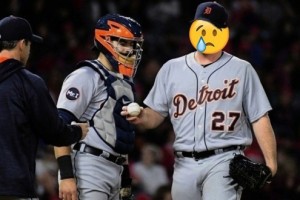
Surprise, surprise, Zimmerann twirled another gem on Sunday. If you look at Zimm’s ERA for each of the past five seasons, his 3.46 mark this year doesn’t look out of place at all: 3.18, 2.94, 3.25, 2.66, 3.66 from 2011 to 2015. Look at his xFIP, though, and it paints a different story entirely: 4.61, up above 3.82 for the first time ever. And honestly, we shouldn’t be surprised. He’s in the American League this year, having to face a DH every ninth batter instead of a pitcher, and he’s in a more hitter-friendly park. Oh, and he has to throw to two of the game’s worst pitch-framing catchers in James McCann and Jarrod Saltalamacchia.
From that lens, you can almost excuse the 4.61 xFIP. Given such terrible context, you’d expect Zimmermann’s peripherals to be worse than his actual talent level would indicate. Indeed, THE BAT has Zimmermann with an underlying, context-neutral ERA projection of 3.70, factoring in his history and neutralizing for the bad context this year. That makes him an above-average pitcher, in a vacuum, but Zimmermann doesn’t pitch in a vacuum. He pitches in the American League. He throws to Salty. And that’s not going to change. When you account for this context, Zimmermann becomes below-average. Every start, that is his real baseline, even if his own skills reflect something better.
When the rest of the matchup dictates, you can get away with playing a below-average pitcher. Except that Zimmermann’s strikeout rate is also down (5.6 K/9), and even with the bad context, THE BAT still only thinks he’s a true 7.4 K/9 guy before it gets dragged down by those parts of his matchups that remain constant. It’s a shame, too, because Zimmermann has always had good stuff. He throws in the mid-90s (or at least used to; his velocity has declined a bit this year). He has a plus slider. But he’s one of those stubborn guys who intentionally forgoes chasing strikeouts in favor of pitching to contact. Now that he’s getting older, his velocity is declining, and he’s no longer managing an average strikeout rate just because his raw stuff does it, I expect him to start crashing. Hard.
If you haven’t surmised as much yet, all of this is to say that Zimmermann is a consistently terrible DFS play despite the favorable results to this point. Even on a day when he may project for a good ERA, the strikeouts will be hard to come by, and they’re such an essential part of DFS scoring. It leaves zero margin for error, requiring Zimm to basically go seven innings while only allowing one run, maybe two. If he were to be priced in the $7,000 range you could consider him on occasion, but when he’s consistently priced around $10,000 on both DraftKings on FanDuel (Sunday was the first time since April he went below $8,000 on either site, and it was only on DraftKings), you just can’t justify it. Avoid Zimmermann at all costs unless there is a sudden shift in context. And honestly, feel free to play hitters against him in the right spots, especially on a site like DraftKings with dynamic pricing where they come at a discount.
FALLING… FALLING… AND FALLING SOME MORE
Giancarlo Stanton, OF, Miami Marlins
After a torrid start to the season, Giancarlo Stanton has fallen off a cliff. Since May 8, he’s posted a .229 wOBA with just two home runs: very un-Stanton-like. I received a lot of questions last week about him, particularly from users of THE BAT, so I wanted to address Stanton. THE BAT still likes Stanton. A lot, especially this past week when his price had fallen down into J.B. Shuck territory. Here’s why: Stanton has been bad for five or six weeks, but before that he’d been one of the elite hitters in baseball for five or six years. All of that talent is still there and will come back out again, and that’s what THE BAT is projecting based on. (Especially since, over this terrible .229 wOBA stretch, Stanton has still posted a 43% hard hit rate).
As an objective, statistics-based system, THE BAT can’t know that something may be wrong with Stanton and that he may not be quite the same player at this point in time. In the case of Stanton, it appears that he’s been playing hurt. I’m going to direct you to my former Baseball Prospectus colleague Mike Petriello, who does Statcast stuff for MLB now and who examined Stanton recently. You should read the whole article, but the bottom line is this: Stanton has been dealing with an ambiguous side injury since spring training but which popped up and caused him to miss time in May. Petriello’s conclusion?
“Stanton is having a hard time making contact on pitches in the zone, particularly those up and in. If he’d actually moved off the plate, he’d in theory be in a better position to hit those, but that’s not what’s happened. In fact, since Stanton’s mechanics starting his swing look the same, a reasonable assertion would be that if the side was an issue, not only would he struggle to make contact, but he’d have a hard time being on time with his swing. That’s exactly what’s happened. Over the past few years, Stanton has always pulled between 42 and 47 percent of his batted balls. Through May 7, he pulled 45 percent this year. Since May 8? Only 38 percent.”
I haven’t played Stanton in several weeks, excluding him any time he tries to pop up in the Lineup Builder. I’m going to need to see some real improvement before Stanton is a viable DFS option again.
PROSPECT SPOTLIGHT
Peter O’Brien, OF, Arizona Diamondbacks
The D’Backs called up O’Brien this week, and he immediately becomes an interesting DFS play. O’Brien has some of the best raw power in all of baseball. He’s already hit 3 home runs in 24 plate appearances in the majors after hitting 67 in about 1000 PA at Double- and Triple-A. The issue, as is often the case with these types of prospects, is the extremely high strikeout rate. And because O’Brien doesn’t take many walks, that kind of aggressive approach could be exploited by major league pitching.
Still, his power is on par with literally anyone in baseball, and he calls a great hitters’ park home. And seeing as how Arizona has batted him fifth a few times, he’s a guy to seriously monitor when the price is right. That price has fluctuated wildly over the past week, going as low as $2,800 and as high as $4,800 on DraftKings, so it’s difficult to know where it will settle. This week he figures to have plenty of great matchups, remaining in Citizens Bank Park on Monday before going into the Rogers Centre and then Coors Field.
RISING… BUT STILL UNDERPRICED
Ryan Schimpf, 2B/3B, San Diego Padres
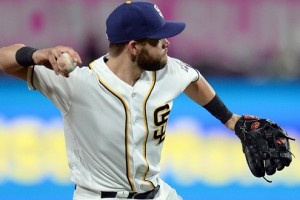
Schimpf was called up with week as well, although he doesn’t come with anywhere near the prospect luster of O’Brien. He’s 28 years old and was signed this past winter by the Padres as a minor league free agent. He just saw his first ever major league at-bat this week, but honestly, I’m surprised it’s taken so long. His minor league numbers are ridiculous, as he’s the owner of a career wOBA around or over .400 at both Double-A and Triple-A. Not only that, but he pairs power with solid plate discipline, and even once you account for the easier competition in the minors, THE BAT still views him as an above-average major league hitter.
He hasn’t done a whole lot yet, but the Padres are running him out there every day, and I’m optimistic that he’ll come around. He was $2,000 on DraftKings for a few days, but he rose to $2,600 on Sunday, which is a bit high for a guy hitting in the bottom third of the order. With lower ownership rates, though, he could slide back to $2,000 this week, but even $2,600 is manageable if the matchup is right. The Padres are on the road in Baltimore and Cincinnati this week, so the matchups could certainly be right. He may or may not be Detlef Schrempf’s son—Dean and I couldn’t verify—but I like him even if he’s not.
FALLING… WITH INTERESTING IMPLICATIONS
Chicago Cubs Pitchers
The Cubs have called up catching prospect Willson Contreras, and word is he’ll make his first major league start on Monday. While young blood can sometimes be a good thing, it won’t be for any Cubs pitcher that has the misfortune of toeing the rubber on days Contreras is calling pitches. Chicago’s current catching duo is excellent defensively: Miguel Montero is near elite, and David Ross is very good in terms of pitch framing. Contreras is well below average, perhaps even poor. DFS is a game of edges, and it’s these hidden edges that can make or break a night or give you that extra little advantage to increase your profitability.
Luckily, having three catchers on the roster means Contreras may not make all that many starts, but it also means that his poor defense will have a very small effect on the seasonal stats and DFS pricing of Cubs pitchers, being buried behind stats influenced by Montero or Ross. So on days that he is catching, it will be a big swing. John Lackey draws the assignment on Monday, and I can tell you right now that I’m highly unlikely to roster him.
BABIP OVERACHEIVER OF THE WEEK
Ian Desmond, OF, Texas Rangers
Ian Desmond has been fantastic this year, transitioning smoothly to the outfield and bouncing back at the plate after his worst season ever in 2015. Apart from separating himself from his weak 2015 season, though, he’s basically the same player he was before. This, of course, despite a career high .367 wOBA, which I’m calling out as somewhat of an illusion. He’s cut back on his strikeouts a bit, but his walk rate is the same, his power is the same, his hard contact rate is the same. You know what’s different? His BABIP. As I’ve often discussed in this space before, people focus on what the wOBA is and not how it was achieved. In the case of Desmond, it comes as a result of a .378 BABIP (.474 this past week), which is nearly 50 points higher than his previous best: .336.
This isn’t to say that Desmond isn’t a usable player. He hits second for a decent offense and plays in a park that is playing extremely hitter-friendly this year and frequently boasts the day’s hottest temperatures. The problem is that Desmond is merely an above-average hitter, and he’s priced in the high-$3,000s-to-low-$4,000s on FanDuel and the high-$4,000s-to-low-$5,000s on DraftKings. I’ve yet to roster him this year, and I can’t imagine I’ll be doing so for as long as he’s overpriced. Additionally, because the Rangers are so lefty-heavy, the days they project for the most runs are days when Desmond projects the worst on an individual level, creating an unfortunate circumstance that makes it difficult to effectively leverage Desmond.