
Risers and Fallers: Volume 9

I’m back for another week of reviewing the most interesting players from the past seven days, pairing advanced metrics and insights from my DFS projection system, THE BAT, with my scouting background to try to figure out what to make of some the week’s most active lot of ballplayers. Guys whose stock is going up, guys whose stock is going down, guys who are perpetually underpriced or overpriced, guys who are worth paying a premium for, or guys who are just interesting and warrant some analysis on.
If anyone ever has a suggestion for a player they’d like to see included, feel free to send me an email or a tweet.
Without further ado, let’s jump right into it!
RISING… AND BRIEFLY UNDERPRICED
Sonny Gray, SP, Oakland A’s
It’s funny. We have these weekly “Sonny Gray is a Fraud Anonymous” meetings, but nobody actually seems to care about the anonymous part. Kind of a misnomer, but what can you do? Us DFSers aren’t necessarily known for our creativity (but more for our ruthlessness in shouting “fraud” at a subsection of the top 1% of athletes on the planet.) I was a pretty proud and prominent member last year, and we “Sonny Gray is a Fraud” truthers seemed to win a pretty decisive victory this year when the wheels fell off the wagon for Gray. With limited strikeout upside (especially in foul-spacious O.co) and a terrible infield defense for all of his groundballs last year, I suspected it was only a matter of time. He began 2016 by posting a 7.7 K/9, 6.19 ERA, 4.53 xFIP over his first nine starts.

Fraudulity (it’s a real word, look it up. If it’s not in the dictionary, well, deal with it) is a matter of context, though. Gray is a fraud when people consider him an ace. Gray is a fraud when he’s priced at five figures. When he’s $6,500, however—if he’s the pitcher we saw last year—he’s a huge bargain. The problem, of course, is that Gray hasn’t been the pitcher we saw last year. (The other problem is that I got jumped in the church parking lot after this week’s meeting because I recommended Gray on Friday’s GrindersLive show, but that’s neither here nor there). At least, he wasn’t that same pitcher until these past two starts. As I tried to explain on GrindersLive Friday (and to DraftCheat in the parking lot), things are looking up for Gray, and there will be a small window of opportunity to take advantage before his price rises and he becomes a fraud again.
Gray’s issues this season were threefold: 1) diminished velocity, 2) loss of command, 3) increased reliance on his worst secondary pitcher (his change-up), while his best (slider) all but disappeared and his second best (curveball) was reduced.
All three issues have been resolved in his past two starts. 1) His fastball is up above 94 mph—where it was last year. 2) He issued just two walks in 12.2 innings. 3) His change-up usage fell from 12% to 1.6% while his slider usage increased from 9% to 11% (14% against the Reds) and his curveball from 16% to 21%. The bump in slider usage in his most recent start is especially promising, as that’s the pitch that makes him most effective. He was throwing 29% breaking balls last year, so he’s now right back in line with his previous, healthy norms.
Considering that he went on the DL before these most recent starts due to a shoulder injury, this narrative makes sense. Shoulders help to generate velocity and, if they’re wonky, may make a pitcher less likely to throw breaking balls. Gray appears to be healthy now but still underpriced, particularly on DraftKings. This week he’ll have a decent matchup against the Rangers at home, and next week he’ll get the Brewers. In both instances, he’ll be a quality SP2 if the salary stays put. So for now, consider me a reformed Sonny Gray is a Fraud-ist. At least for another week or two.
RISING… AND NOW OVERPRICED
Tim Anderson, SS, Chicago White Sox
Anderson had a brief moment in the sun this weekend when he was called up to the show, priced at just $2,000 on DraftKings for two days, and was a must-play on Friday. (Because we all know that the highlight of an MLB player’s career is being touted by yours truly in DFS). He rose to $2,900 on Sunday, which is now out of range for being a usable cash game option. This isn’t to say that Anderson isn’t a legitimate prospect. He’s the top prospect in the White Sox system, in fact, and should go on to have a pretty solid MLB career. But he’s not the most appealing for DFS purposes when he’s batting ninth and not minimum price.
Anderson projects for plus contact ability and speed (and is an above-average defender), but he has no power or patience, which makes him a below-average hitter overall (especially while he’s striking out at an above-average clip). He calls a good hitters’ park home and has an underrated surrounding offense, but he’s just not playable unless he gets a chance to hit second in the order or until his price falls back to the minimum. He’ll certainly get a chance to earn it with Jimmy Rollins off the roster entirely, but I’m not overly optimistic about his ability to do so in the short term.
RISING… BUT STILL UNDERPRICED
Hyun-Soo Kim, OF, Baltimore Orioles
Kim is one of the most compelling stories of this MLB season. He received some hype when the Orioles signed him over from Korea in the offseason, initially being slotted in as the leadoff hitter in projected lineups, and then he received some reverse-hype when he stunk up spring training so badly that the Orioles were having meetings to discuss how they could get out of having him on their roster. They wanted to send him to the minors; Kim refused. They wanted to send him back to Korea; that was too complicated, also requiring Kim’s agreement and a willing KBO team. They debated straight-up releasing him. Ultimately, they decided on burying him on the bench and letting Joey Rickard lead off. That worked for a time, but then they realized Joey Rickard was leading off. Finally, Kim managed to sweet-talk his way into the lineup. (Or, I suppose, his interpreter did the sweet-talking. If it was me, I would have undone a couple extra buttons and gotten him into the lineup by the second week of April, but not everyone possesses those skills, I suppose.) Since then, he’s been Baltimore’s most productive hitter, posting a .388 wOBA.
Given the turbulence of his journey to this point, what can we actually expect from Kim? He’s certainly not a true .388 wOBA hitter, but how good is he? One of the strong points of my DFS projection system, THE BAT, is that it incorporates data from foreign leagues, which can help us paint a clearer picture of a guy like Kim when we’d otherwise have just 98 MLB plate appearances to look at.
Much of Kim’s success this year has been a result of a .392 BABIP—38% better than the league average. It should be clear by now how I feel about BABIP overachievers, especially when there is no history of it. In Korea, Kim was within 4% of the league average for the past six years—and that’s before translating to the higher difficulty of Major League Baseball. In essence, Kim’s BABIP is much higher than we should expect it to be.
That being said, Kim is no fraud. While his BABIP is certainly fraudulent, he has other skills that make him a quality player. He doesn’t strike out, he takes walks, and he showed more power in Korea than he’s shown this year. He’s very firmly an above-average hitter, and he’s now firmly entrenched as Baltimore’s number two hitters against righties. His price is still quite low on DraftKings ($2,700) and manageable on FanDuel ($2,800), so he’s a guy that’s worth consideration in good matchups.
Michael Pineda, SP, New York Yankees
Pineda has been one of the most perplexing pitchers in baseball over the past six weeks. His ERA sits at a horrendous 6.14 ERA while his xFIP is a quite excellent 3.60. He’s getting strikeouts, he’s limiting walks, his hard contact rate is about average, but he’s giving up hits and home runs. Why? Hell if I know. I dug into him a couple weeks ago and mentioned on GridersLive that I couldn’t find anything. Eno Sarris at FanGraphs did the same and reached the same conclusion.
I’ve run him out there the past three starts because, honestly, unlike with certain other pitchers (Dallas Keuchel, for instance, or Sonny Gray up until recently), this looks mostly like bad luck to me. Over those starts (which have all been solid matchups, granted), he’s posted a 2.89 ERA with 18 K and 2 BB in 18.2 IP. He cost just $6,700 on DraftKings and $7,800 on FanDuel on Sunday and was an easy SP2 or GPP play if you could get over the ugly seasonal ERA. He’ll get Minnesota in his next two turns in the rotation and could once again be a solid play if his cost remains low.
PROSPECT SPOTLIGHT
Blake Snell, SP, Tampa Bay Rays
Snell made a spot starter earlier this year, but word is that he’s going to be recalled this week and could finally be up for good. And I have to say, I’m excited. Snell is one of the top pitching prospects in the minors, and I was certainly impressed in his first start. Scouts said his fastball was more low-to-mid-90s, but he was throwing a firm 95 in his first start with absolutely ridiculous rise. His change-up and slider both flashed plus, and he’ll mix a curveball in for good measure. The problem is the control, as he’s struggled to prevent walks throughout his minor league career. Still, the overall package is impressive, and as we’ve seen with plenty of other pitchers (teammate Chris Archer, for instance), you can get away with giving up walks if you’re piling up the strikeouts in DFS.
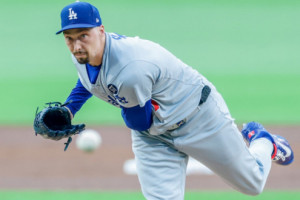
A good statistical comparison is Tyson Ross with fewer groundballs. He’s a guy who gets strikeouts, can be wild at times, but is ultimately an effective, above-average (maybe borderline good) pitcher. That’s the level that THE BAT projects Snell at right now, which is phenomenal for a guy who’s made all of one major league start. With a good home park and solid catching from Curt Casali (near-great when it’s Hank Conger), the context is there for Snell too.
Assuming Snell is priced affordably—anywhere below $8,000 would be great—he’ll be a perpetual DK SP2 and FD GPP option in good matchups. Unfortunately his first few turns aren’t ideal. He’ll get the Mariners at home this week, which could be okay if he’s cheap enough, followed by the Cleveland in Cleveland and Baltimore in Baltimore. The latter will have some upside, but I don’t see a matchup I really love until Detroit at home at the end of the month.
Albert Almora, OF, Chicago Cubs
In many ways, Almora is the outfield version of Tim Anderson. He’s a legitimate prospect with pedigree and upside, but his immediate DFS prospects are lukewarm at best.
He hasn’t shown much power or patience in the minors, instead relying on contact hitting, defense, and a little speed (much less than Anderson, though). He keeps his strikeout rate much lower, which may make him a better bet for hits—or maybe not. Because he doesn’t take walks or strikeouts, that basically means he swings at everything. You can get away with that to an extent in the minors, but it’s much harder for an inexperienced player to consistently square up balls in the majors when he’s swinging at so many of them. In fact, Almora’s minor league BABIPs have been pretty mediocre at times. He projects for more power down the line than Anderson, but it hasn’t manifested yet. Overall, Almora too is a below-average hitter at present.
He hit sixth in his first start (which could make him playable when the matchup is perfect and price is cheap) and eighth in his second (which would make him all but unplayable), and now the Cubs have Chris Coghlan in the outfield mix while Jorge Soler is on the DL. A $2,000 tag on FanDuel is as good as it gets (though you won’t often need to dig deep enough on FanDuel for a player of Almora’s caliber), but a $2,800 tag on DraftKings is too high.