
Things We Know and Things We Don’t

I’ve had quite a few requests to write an article breaking down my DraftKings Main Event team. Rather than just going through my lineup, I’m going to combine that analysis with what I was already planning to write an article about. That is idea of leveraging your baseball knowledge by looking at two big picture categories of information; things we know, and things we don’t know. That probably sounds a little silly and simplistic on the surface, but sometime it’s best to look at things from a very simple black and white perspective.
If you’ve been playing DFS baseball for any period of time, you understand that there is a lot of variance night to night in this game. The “correct” plays don’t always pay off, but over time, if you continuously make the right decisions, you will come out ahead. I think it is crucial not to ever think you are smarter than you are, or that you know for sure what is going to happen.
However, it is equally important not to doubt your analysis when the right plays don’t work out. If you can learn to separate the things that you know from the things that you don’t know, it can give you a big edge, especially in tournament play. Let me try and explain more clearly what I mean with a breakdown of the winning lineup.
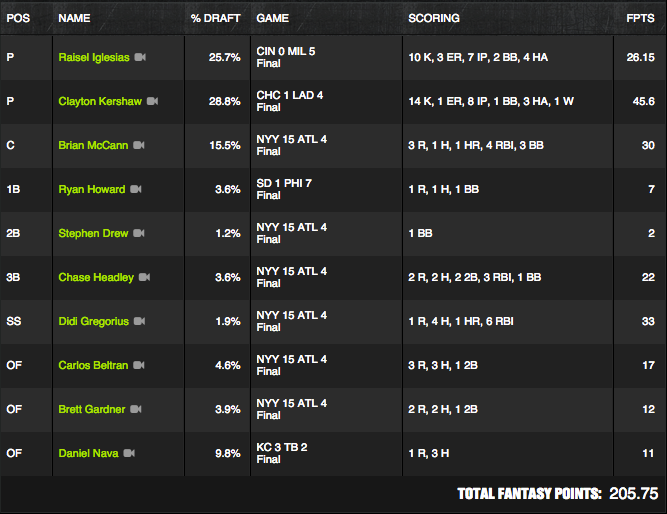
STARTING PITCHER #1 – Clayton Kershaw – Things We Know
Clayton Kershaw is the best pitcher in baseball, period. This is something we know. There is far less variance in the top pitchers than in any other spot in baseball, and that makes them worth paying for.
It never crossed my mind for a second not to use Kershaw in this tournament. I understand that his price was high, but these were guaranteed points. Strikeouts from a pitcher are one of the most predictable stats (things we know), and he was facing a Cubs team that has the highest strikeout rate in the league (things we know). I was hoping he would be under owned due to his price but that was not a factor in my decision to use him.
STARTING PITCHER #2 – Raisel Iglesias – Things We Know, Things We Don’t
The great thing about last Friday night was that there were a lot of good pitchers on the mound. Most days, I find five or six pitchers that I’ll consider using in tournaments. Last Friday, I had 14 pitchers on my list that I considered to be worthy plays. That is a lot. Because there were so many options, I decided not to even consider ownership percentage when picking my second starter.
As I mentioned with Kershaw, you need strikeouts from your pitcher, and the thing we know about Iglesias is that he has elite strikeout ability. What we do not know about Iglesias is whether or not he is reliable from start to start. He doesn’t have a long enough track record to be confident that he is going to be able to have his best stuff every time out. Obviously, his cost, $7,800 was a big factor in using him, but the very simple reason why he was my second pitcher is because of the one thing we do know about him; high strikeout potential. I was willing to take a chance on something I didn’t know for upside of something I do know with a single entry in a large field tournament.
WHAT TEAM NOT TO STACK – Things We Know About Toronto
1) The Toronto Blue Jays are the best offense in the league by a wide margin
2) The Blue Jays are unstoppable at home, especially against left-handed pitching.
3) The Blue Jays had the highest team total on the night by a wide margin.
4) The Blue Jays are likely to be the highest owned stack. – This is in between something we know and something we don’t.
Ownership percentage can be approximated, but it’s still a guess.
5) You can’t afford Kershaw/Iglesias/Donaldson/Encarnacion/Bautista/Tulowitzki. It can’t be done.
6) Tigers starter Matt Boyd gives up a lot of fly balls. That leads to home runs, which is good. But, fly balls also lead to outs instead of base runners, which is bad.
WHAT TEAM NOT TO STACK – Things We Don’t Know About Toronto
1) Which Blue Jays hitters are going to hit home runs?
2) Will there be runners on base when they hit those home runs?
3) Is it possible to win a Toronto stack without one of the big four batters at the top of the order?
4) If so, which batter can you leave out?
5) If I have one entry vs dozens for other top players, and the Blue Jays are the top play of the day, can I win this tournament with a Blue Jays stack even if they score 20 runs?
Because I was using Kershaw no matter what, the decision to avoid Toronto was an easy one. But I would not have used them even if I could have afforded them, because I was using a single entry approach to this tournament. When you need to finish first place, you don’t need a bunch of solo home runs at high prices. What you need is a bunch of runs at affordable prices, and ideally with some home runs mixed in.
WHAT TEAM TO STACK – Things We Know About The Yankees
1) The Yankees are the second highest scoring team in the league.
2) The Braves starter, Williams Perez, was one of the worst pitchers on the slate. Low strikeout rate, high walk rate, 5.07 SIERA, and a bad bullpen behind him.
3) The Yankees were on the road in a National League Park, with Mark Teixeira injured and Alex Rodriguez on the bench with no DL slot.
4) The lack of two star players along with no DH will lower ownership. Again, this is somewhere in between things we know and things we don’t.
5) Players who hit towards the bottom of the lineup are lowed owned.
WHAT TEAM TO STACK – Things We Don’t Know About The Yankees
1) Where will the Yankees runs come from?
2) #1 was it. That’s all we didn’t know. Of course, teams that “should” score runs sometimes get shutout, but you can “know” things, and have them not work out. When you do the correct analysis, you need to trust the results you get. This is where variance meets knowledge.
The best plays are not a matter of whether you know that they are the best plays. The best plays are a matter of whether or not they actually work out that day. I hope that makes sense what I just said; that is a big key to success in DFS. Read that again and let it sink in; I hope you’ll understand what I’m saying there. Study the data, find the plays, and know that they are right. What we don’t know, is whether or not today will be the day they come through for you. If you now look back to the list of ‘things we don’t know about Toronto’, you’ll notice that none of those things are whether or not they were a good play. I was counting on several Blue Jays home runs, this was not a fade because Toronto was a bad play. It was a fade because of cost and ownership.
HOW TO STACK THE YANKEES – Things We Know
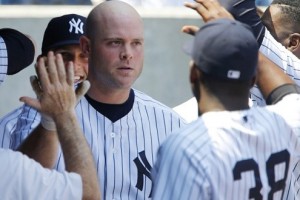
1)Brian McCann was the only must-play Yankees hitter, everything else was under consideration. Catcher is a tough position to find upside, and while I wasn’t looking for a barrage of home runs from the Yankees, I did want to make sure I had the most likely source of a home run, especially if it was from a scarce position. Things we know – Home Runs Come From Fly Balls – Brian McCann has a 50% fly ball rate against right-handed pitching
2) With the cost of my pitchers plus Brian McCann, I could only afford one of Jacoby Ellsbury and Brett Gardner. Things we know – In blowouts, players get pinch hit for. Things we know – Ellsbury had missed the previous game with a hip injury. This made it a very easy decision to play Gardner instead of Ellsbury. It worked out just that way, as Ellsbury was pinch hit for and did not get to face Jonny Gomes in the ninth inning, while Gardner got the extra at-bat and ended up hitting a double.
3)Carlos Beltran has a premier lineup spot, is a switch hitter, and is a more proven player than first baseman Greg Bird. Basically, the big decision came down to Bird plus an OF from a different team vs Beltran and a 1B from a different team. Beltran is much more of a “thing we know” than Bird, and I was able to find a “thing we know” situation at first base.
HOW TO STACK THE YANKEES – Things We Don’t Know
1) Will Stephen Drew and Didi Gregorius get a big enough role in the Yankees scoring to make them more valuable than more talented hitters on other teams? It turns out that Gregorius was the player more so than any other that won me this tournament.
It is important to note that he was not a “thing we know”. What this came down to, is I couldn’t find any better plays at the cost of the Gregorius/Drew combo that fell into the “things we know” category. Siding with the seventh and eighth hitters for the Yankees became the plays not because of what we knew about them, but because we know that players that hit toward the bottom of the lineup are lower owned. The clear best play was to go further in on the Yankees stack with players that would not be highly owned. There was a more likely upside that Gregorius and Drew were a big part of a high scoring Yankees lineup than that I could find a low priced middle infielder elsewhere to give me those points.
FILLING IN THE PIECES – Things We Know
1) First base is a position loaded with power hitters who have home run potential.
2) The Yankees’ Greg Bird is an unknown quantity.
3)Ian Kennedy gives up a tremendous amount of home runs, fly balls and hard contact to left-handed batters.
4)Ryan Howard will not be highly owned due to all the other available first baseman. Again, with ownership percentage, it falls somewhere in between things we know and things we don’t.
5) After filling out my two pitchers, Yankees stack and Ryan Howard, I need a minimum salary outfielder.
6)Daniel Nava is a switch hitter batting second in the lineup.
7) Switch hitters do not get pinch hit for nearly as often as other players.
8) The last time I played Daniel Nava in a big tournament, I won a million dollars.
OK, a little joke on the last one there, but really, Nava was an easy play for me on Friday. There were not a lot options at $2,000, and hitting second in the lineup and being a switch hitter was a big deal. The Ryan Howard pick is the one I liked the best out of my entire lineup. Because he didn’t do anything special that night, it went a little unnoticed, but the 3.6% ownership percentage was exactly what I was looking for. He had big upside, and he was a way to differentiate myself from the crowd.
Because I was using a full 6-player Yankees stack, I wanted a low-owned, high upside player outside of the stack, and first base was the place to find it, thus making Greg Bird the player to leave off my Yankees stack, along with Jacoby Ellsbury.
I hope some of this information is useful to you. I want to again point out something I said that I think is a huge key to DFS baseball success, especially in tournaments:
The best plays are not a matter of whether you know that they are the best plays. The best plays are a matter of whether or not they actually work out that day.
There were a lot of things I knew that were in play for this million dollar lineup, and there were also some things I didn’t know.
That will be the case every day you play. Find the things you know, and don’t second guess them. When you come across things you don’t know, step back and look at the big picture, and see where you can get the biggest upside from them.
Now go win that next million – I highly recommend it!