
Postseason Pitching Preview – National League


Starting pitching in the postseason is a completely different animal than the regular season. With the magnitude of importance every game, every inning, perhaps every out carries, starters are given much shorter leashes in the postseason. There’s no other position in any other sport you can even compare it to. In other sports, you expect teams to go with what got them there. Star quarterbacks don’t get pulled from NFL playoff games at the first sign of trouble. The baseball postseason means that the bullpen is going to play a much bigger role in order to mix and match and create the optimal matchups for the defense much sooner than they would normally be.
In one way, it is a little bit more like other sports. During the regular season, you’re projecting performance. You already know the opportunity that’s going to be presented (save pinch hitters, but you already know which players are more at risk for that) once the lineup card is out. In football (and basketball, though I don’t play), you’re often trying to project opportunity. You’re now doing the same thing with starting pitching in October.
This is the last in a two part series taking a look at both the American League and National League pitching staffs in the postseason, previewing the projected starting pitchers, the matchups, and also taking some educated guesses about managerial tendencies to see if we can figure out which managers may go quickly to the bullpen and who might let their starter get out of their own jams.
New York Mets vs Los Angeles Dodgers
It’s Moneyball vs the Extra 2% as many of the major front office pieces in two of the most popular and revolutionary baseball books of the last 20 years are present in this series, of course with different teams now. You can see some similarities in these teams too as they both heavily favored platoons late in the season and rode the backs of dominant pitching through the tough times to get to where they are now. It should be a fun series with some exciting pitching matchups.
Park Factors (3 year overall run factor via Seamheads.org and 2015 only via ESPN)
Citi Field in New York = .88 (S), 0.87 (E)
Dodger Stadium in Los Angeles = .89 (S), 0.92 (E)
New York Mets
Opponent
Vs LHP 111 wRC+ (3rd), 20.7 K%, 12.4 HR/FB, 11.0 Hard-Soft%
Vs RHP 104 wRC+ (4th), 20.6 K%, 13.0 HR/FB, 13.2 Hard-Soft%
Home 111 wRC+ (3rd), 20.7 K%, 13.1 HR/FB, 13.8 Hard-Soft%
Road 101 wRC+, 20.1 K%, 12.5 HR/FB, 11.5 Hard-Soft%
The Mets rode a young, dominant, and at times controversial pitching staff to an NL East title. Controversial in terms of managing innings caps through the end of the regular season so that they would all be available for necessary workload in the postseason. While a couple of them struggled down the stretch of their first full major league seasons, after a couple of skipped starts here and there, they all rebounded strongly to close the season.
The Dodgers were a well balanced offense in almost any situation you put them in. Multiple injuries forced them to make some moves and employ frequent platoons and may have helped them build some depth over the long run. While they don’t have many dominant bats that you absolutely need to pitch around, it’s tough to find areas of weakness that you want to attack.
Projected Starters
Jacob deGrom exceeded his 2014 Rookie of the Year campaign in many ways. His 22.2 K-BB% was 4.3 points higher with a 2.54 ERA and ERA estimators all just under three. After struggling for a bit down the stretch, he skipped a start and finished up with one run in 10 innings, striking out 16 of his last 37 batters. Though he was better at home, he still has strong numbers on the road (3.09 ERA, 20.6 K-BB%, 3.28 xFIP). The biggest difference was a 2.9 HR/FB at home vs a 14.0 HR/FB on the road with a 10 point higher fly ball rate (29.6% vs 39.4%) as well. Contact authority rates weren’t much different. The Dodgers have an above average offense in all situations, but similarly negative run environments in both parks could mute the offense. deGrom should be usable as a reasonable GPP pivot from Kershaw at a likely much lower price.
Noah Syndergaard very similarly bounced back from a late season rough patch with some extra days off here and there to finish up with three ERs in 14.2 innings, striking out 21 of 54 batters. He finished with a 22.4 K-BB% that led the team to go along with a 3.24 ERA/3.25 FIP, while his xFIP and SIERA were just below three. Similar to deGrom, there was some concern about his road numbers (4.23 ERA, 3.44 FIP, 20.6 K-BB%, .330 BABIP, 67.6 LOB%, 15.0 HR/FB). However, he had HR issues at home too (13.7 HR/FB), and especially late in the year (13 of his 19 HRs over his last 10 starts), but balanced that out with at least eight strikeouts in five of his last six starts, including each of his last three road starts. Of the Mets big three, he may be the highest risk, but also offer the highest upside, leading the team with a 27.5 K%.
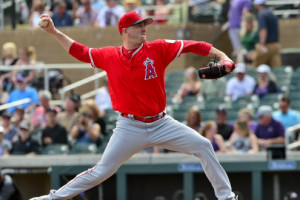
Matt Harvey had a controversial final month, but after being limited to under 80 pitches in two consecutive starts, he told the manager he wanted the ball and went 90+ pitches in each of his last two starts, striking out 17 of 52 batters, allowing just two ERs in 12.2 innings. This bodes well for his Game Three start at home, where he also pitched better (22.6 K-BB%, 2.23 ERA, 2.88 FIP). The Dodgers aren’t below average anywhere, but are most vulnerable on the road vs RHP and will be in a tougher, cooler environment in New York.
Steven Matz should get the ball in Game Four if he’s healthy and it seems to be leaning that way right now. His bullpen issues have gone well after dealing with a side issue and if another simulation goes well Thursday, he’ll be on pace. He started just six games this year for the Mets due to a late call up and a couple of injury issues. He just didn’t look the same after coming back from his first trip to the DL. That’s not to say that he isn’t just as talented as the Big Three, but he will be watched closely with all hands on deck in a potentially crucial situation, which would concern me if asked to pay up for him. In four September starts, he went a total of 22 innings, allowing just seven ERs, but walking five with 20 strikeouts (97 batters). That’s not bad from your fourth starter, but might not have lived up to all the hype yet either.
Bartolo Colon will only start if Matz doesn’t pull through and possibly then even only if the Mets are up in the series. He too faltered a little bit down the stretch after a long scoreless streak in August. He struck out three or fewer in each of his last five starts, but looked good out of the bullpen, where they’d prefer to keep him. He likely doesn’t have the strikeout rate to keep you interested if he indeed does get the start.
Managerial Tendencies
Terry Collins has some old school views and makes some mind-boggling decisions at time, but appears to have come around to a more modern way of thinking at least in terms of stuff like lineup construction. He has been faulted at times for his use of starters and bullpen, occasionally pushing his young studs a bit further than some people felt comfortable with. There are many factors (including innings caps) that would tend to make one believe he’ll be conservative and quick hooked with his starters in this series, but the truth is that the bullpen has struggled over the last couple of weeks, aside from his closer (Familia), and he might be hesitant to go to them early if his starters are pitching well. I don’t believe he has confidence in his late inning setup men (Reed, Clippard) right now, though a healthy Matz will extend the relief corps with Colon and Niese.
Los Angeles Dodgers
Opponent
Vs LHP 102 wRC+, 23.6 (2nd), 13.4 HR/FB, 15.3 Hard-Soft%
Vs RHP 98 wRC+, 20.2 K%, 11.0 HR/FB, 13.0 Hard-Soft%
Home 99 wRC+, 20.9 K%, 11.5 HR/FB, 11.9 Hard-Soft%
Road 99wRC+, 21.1 K%, 11.6 HR/FB, 14.9 Hard-Soft%
The Dodgers have a dominant Ace (with a possible playoff narrative now), a great #2, and a competent third, before getting to a questionable fourth, but if there’s any concern about elimination, you can be sure that Ace will be back to pitch Game Four.
The Mets offense floundered through the first four months of the season, being kept afloat only by their pitching, before making some trades at the deadline that changed everything. For the next month they were the best offense in baseball until coming back down to earth in September. What the trade deadline (Cespedes, Uribe, Johnson) and some key guys coming back from season long injuries (Wright, d’Arnaud) really did was deepen the roster and allow the team to frequently platoon, matching up well with both left and right handed pitching. You can see that they have a wRC+ between 98 and 102 in all situations above. An injury will keep one of their more potent lefty mashers (Juan Uribe) out of this series and Terry Collins has interestingly stated that he’s going to employ lefties Granderson, Murphy, and Duda all in same handed matchups in this series. We’ll see if that lasts.
Projected Starters
Clayton Kershaw is the best pitcher in baseball and even better than that at home, where he had a 32.4 K-BB% this year and 1.67 ERA with estimators to match. He now has a bit of a post-season narrative considering what’s happened the last couple of years against the Cardinals. Who really knows if that’s a thing and we’ll acquire more information through expanding the sample size in this series, but the smart money is on post-season Kershaw eventually pitching like regular season Kershaw over a long run we may never get to. He is the one guy in this post-season that you can bet will be allowed to go as deep as his arm will let him because even a reduced Kershaw multiple times through the order is better than most other pitchers.

Zack Greinke had a 1.66 ERA deflated by a run from his 2.76 FIP due to career years in BABIP (.226) and LOB% (86.5). Those things are in no way sustainable, but shouldn’t take anything away from a guy who threw 222 innings with a 19.0 K-BB% and 4.9 Hard-Soft%. He’s the top guy on most other major league pitching staffs, just not two in this series. He finished up the season with at least seven innings and two ERs or less in each of his last four starts, striking out seven or more three times. I expect Mattingly to give him a leash nearly as long as Kershaw, which makes him usable even if you have to pay up.
Brett Anderson does not generate a lot of strikeouts (15.5%) and that limits his ceiling, but what he does do better than just about anybody is generate tons of weak ground balls (66.3 GB% led the majors, -1.2 Hard-Soft%). When the opposing offense can’t elevate or make solid contact, it often limits the trouble a pitcher can get into without experiencing a run of poor luck. Where he was lucky this year was the injury front. This was the first year of his career with more than 30 starts and first with more than 20 since 2009. While he didn’t always come through, his low price tag through most of the year allowed DFS players to come out ahead with his usage more often than not. He might be an option at an average or better price tag as your pitcher #2, but don’t expect him to see the same lenience as the two big dogs.
Alex Wood will not step on the mound in Game Four (at least to start) if the Dodgers are facing elimination. That responsibility will surely fall to Mr. Kershaw. Wood has been inconsistent at best in 12 starts since being traded. He has looked very good at times, but absolutely terrible at others. He had exactly one strikeout in three of his Dodger starts and finished with an ERA and FIP over four with a 16.8% for his new team. I’m not sure we can trust him in a daily fantasy setting when there will likely be better pitchers available and even opposing him.
Managerial Tendencies
Don Mattingly was as old school and stubborn as they come until the Tampa Bay brain trust came over to run the Dodgers. That’s not to say they reinvented Donnie Baseball, but he seems to be more open and receptive to progressive concepts this year, particularly in regards to platoons. When you have guys like Kershaw and Greinke, you don’t have to do a lot of thinking in terms of bullpen usage as those guys will often get you right to a dominant closer. The Dodgers had an above average bullpen overall with a FIP and xFIP about a half run lower than their 3.91 ERA. I don’t doubt that Mattingly will try to get his top two as close to Kenley Jansen as possible, but he does have capable pitchers in Pedro Baez and Yimi Garcia should he need them and some competent depth should he need them in later games as well.
Chicago Cubs vs St Louis Cardinals
The Chicago Cubs easily took the Wild Card game from the Pittsburgh Pirates and now this amazing group of young players travels to take on the division winners in St Louis. We should see this gang causing trouble in the National League Central and challenging that championship drought for years to come. If the Cubs are the youth movement, then the St Louis Cardinals are the old guard because no matter what happens, here they are again with the best record in baseball and the only team to win 100 games. Either they or the San Francisco Giants have represented the National League in the World Series every year since 2010. They really had to earn it this year, losing more key players to injury than I can ever remember and most recently one of their top pitchers in Carlos Martinez for the season just after getting clearance on Adam Wainwright to pitch out of the pen.
Park Factors (3 year overall run factor via Seamheads.org and 2015 only via ESPN)
Wrigley Field in Chicago = 1.05 (S), 0.95 (E) – Though it likely varies on a daily basis more than any other park depending on the wind.
Busch Stadium in St Louis = .98 (S), 0.93 (E)
Chicago Cubs
Opponent
Vs LHP 83 wRC+, 23.6 K% (2nd), 10.9 HR/FB, 3.2 Hard-Soft%
Vs RHP 102 wRC+, 19.5 K%, 9.6 HR/FB, 13.7 Hard-Soft%
Home 102 wRC+, 19.3 K%, 8.5 HR/FB, 13.7 Hard-Soft%
Road 91 wRC+, 22.0 K%, 11.5 HR/FB, 8.3 Hard-Soft%
The Cubs had four pitchers make over 30 starts, but it was pretty clear who the big dog dogs in this rotation were as Lester and Arrieta each exceeded Kendricks and Hammels by more than 25 innings, though the latter two both has ERAs higher than their estimators. With the Big Two making 60% of the starts in this series, they have a legitimate chance against anybody.
The Cardinals seemed to lose a key bat to an injury every time another one came back, but at least have Matt Holliday back now and that should help out what’s been an awful offense vs LHP this year. The offense wasn’t dominant this year, if it was even average. It’s kind of difficult to understand how they won so many games, they just did. You could actually consider the offense a weakness of this team.
Projected Starters
Jon Lester seems to be in a great spot here and you can’t often say that about a Wild Card team going into the house of the team with the best record in baseball, but the Cardinals were awful against LHP this year with the 2nd highest K% in the majors behind only, yeah, the Cubs. Matt Holliday will help them from the right side, but won’t solve all their problems. Strangely enough, the Cardinals had six regulars, including lefties Carpenter and Heyward at or above 100 wRC+ vs LHP, but nobody with 100 plate appearances had below a 22% K rate and all other hitters among regulars (more than 70 PA vs LHP) were absolutely terrible, though Piscotty and Pham gave some hope in smaller sample sizes.
Jason Hammel pitched well at times and ended with a career high 24.2 K%, but rarely completed even six innings (just four times in his last 20 starts) and allowed 12 of his 23 HRs over his last 13 starts. I don’t know if he’ll get Game Two or Game Four, but while he may generate a few strikeouts, you can’t expect any length out of him as his manager showed little lenience with him even during the regular season.

Jake Arrieta likely gets a longer leash than you would expect Joe Maddon to give any starting pitcher in the postseason, as seen in the Wild Card game, because he’s pitching better than almost any pitcher ever has over the last two months. There’s nobody the Cubs can bring in that’s going to be better than him. Since August 20th (eight starts, not including the Wild Card game), he has a 0.27 ERA with a 27.9 K-BB% and 66.2 GB% (though obviously higher estimators with an absurd .187 BABIP and 92.9 LOB%). The only concern here is that his price might be prohibitive, especially if the wind is blowing out in an afternoon game. Even then, his upside trails nobody at this point.
Kyle Hendricks had a 3.95 ERA, but much lower estimators (3.36 FIP/3.25 xFIP/3.37 SIERA) and finished strong. Regular readers of my Advanced Stats pitching article this season might recall that he was a speculative favorite several times over the last few months due to underlying numbers that seemed to suggest some upside. You were rewarded if you stayed with him until the end because over his last three starts (six innings each), he allowed a total of three runs (all in the first start) and struck out at least eight in each outing. I’m wondering (because I’m writing this just after the Cubs punched their ticket) if he’s even earned a Game Two start here. If so, I still think he can be an interesting sleeper at an average price tag.
Dan Haren is likely the odd man out here with a 4.01 ERA and estimators a half run higher in 11 starts with the Cubs. I’d have a hard time seeing him bumping any of the others and even if he did, I’d have a difficult time rostering him, although he did finish strong (13.1 IP with one ER and nine Ks), which might make a case for him over Hammel.
Managerial Tendencies
Joe Maddon is the managerial face of the sabermetric and analytical movement in baseball. You think it’s pretty clear and simple how he’s going to handle this pitching staff, but he might surprise you at times, like letting Jake Arrieta go the distance on 113 pitches in the Wild Card game. Then again, who could he have brought in that would have been an upgrade? I’ll speculate that he’ll let Arrieta and Lester do their thing (at least the first time around), but be quick to hook and match up with other pitchers if necessary. He may do some unorthodox things at times, but they are always well reasoned and you can count on Maddon to always know the optimal move in any situation.
St Louis Cardinals
Opponent
Vs LHP 89 wRC+, 26.2 K% (1st), 9.4 HR/FB, 10.9 Hard-Soft%
Vs RHP 98 wRC+, 24.0 K% (1st), 12.6 HR/FB, 12.4 Hard-Soft%
Home 97 wRC+, 24.0 K% (1st), 13.5 HR/FB, 12.4 Hard-Soft%
Road 96 wRC+, 25.0 K% (1st), 10.5 HR/FB, 11.8 Hard-Soft%
The Cardinals rotation limps into the playoffs. Lynn and Wacha haven’t been the same over the last month or two and losing Carlos Martinez is a huge blow, but they are still left with capable starters and found a way to be the only team to break the 100 win mark.
The Cubs have some power, but make no doubt that it was pitching and defense that got them here. By wRC+ and runs scored they were average at best and struck out more than any team in baseball in just about all situations. The high strikeout rate will be the biggest reason to speculate on the Cardinal starters.
Projected Starters
John Lackey is not the ideal guy to open a postseason series, but it definitely makes sense that he starts at home where a 7.3 HR/FB that was well below his 12.4 road HR/FB led him to 3.30 FIP, while an 88.1 LOB% further helped him to a 1.93 ERA. St Louis greatly suppresses power, especially from the right side and Lackey’s 20.7 K% at home should be helped by a Cubs lineup that strikes out a lot. He’ll be one of the lower priced Game One pitchers in the best spot he could possibly be with some upside, but probably won’t have the same extended leash as most other Game One starters.
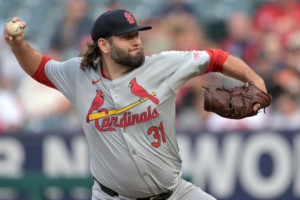
Lance Lynn would have made the most sense for Game Two as the other pitcher with the biggest home/road splits at one point this summer, but went through a rough stretch at home after the All Star break while pitching a bit better on the road to finish with an identical 7.7 HR/FB at home and away. Overall, his hard contact and HR rates shot up in the 2nd half, while his K-BB% was cut in half (17.2% vs 8.4%), though he was able to strand nearly 80% of his runners in both halves. I don’t yet know what game he’s pitching, but would feel more comfortable using him at home if forced to at a higher than average price. However, I often feel that he’s accurately or even over-priced and wouldn’t want to touch him on the road unless the wind is really blowing in at Wrigley. I expect all of the Cardinal starters to have a short leash.
Jaime Garcia would have been the 4th pitcher in the majors with a ground ball rate over 60% (61.2%) if he had enough innings to qualify. Like many of the other high ground ball rate pitchers, he too generated a lot of weak contact (6.0 Hard-Soft%) and had a respectable 19.0 K% just below average. Due to that high ground ball rate, he’s likely the best candidate to pitch on the road in a park like Wrigley Field in Game Three. The Cubs should also increase his strikeout rate (their 26.2 K% vs LHP was easily the highest in baseball) and with just six HRs allowed in 129 innings, he’d be a reasonable start at a reasonable price, though we’re still concerned about a potential early hook. We can probably say that about most Game Three pitchers though.
Michael Wacha had a 3.38 ERA, but some fairly average underlying numbers and estimators, including a 12.7 K-BB% and 3.87 FIP/3.88 xFIP. He allowed pretty average contact authority too (8.8 Hard-Soft%). He’s had his moments, but really struggled with control down the stretch and failed to go more than five innings in four of his last five starts. His 181.1 innings are way more than he’s ever pitched in a professional season and I figure he’ll be over-valued by price and watched very closely by his manager, although he too should benefit from the increase in strikeouts that facing the Cubs gets, His walk rate could get him in a lot of trouble quickly if the wind is blowing out at Wrigley.
Managerial Tendencies
The Cardinals have been known to go to their bullpen early and often in recent post-seasons and the looks of this current rotation along with the addition of Wainwright to that bullpen, might make the decisions even easier this year. Although the bullpen ranked only 22nd in innings pitched, they had four relievers make at least 68 appearances, led by “(player-popup)Kevin Siegrist”:/players/kevin-siegrist-15127’s 81. Beware that all Cardinal starters are on notice and proceed accordingly. It would be a surprise to see many St Louis pitchers get much more than two go arounds through the lineup.