
Stop Wearing DFS Reebok!


Reebok.
I wonder what you think of when you read that word. I’m guessing it’s different from what I think of.
It all started when I was a kid. Nike was everywhere at the time (well…I guess that hasn’t changed). Nike was, in every kid’s mind, the pinnacle of “cool.”
But me? I wasn’t having that.
I didn’t know a whole lot about Nike at the time. I didn’t know a whole lot about Reebok (I was a kid, after all…and there was no such thing as “Internet in homes” for me to learn why one might be better than the other). All I knew was that everyone liked Nike…so I decided that Reebok was my favorite.
We didn’t have much money growing up, but I got a pair of second-hand Reeboks, and I wore them all the time. I explained to people how the honeycomb things (what were those, anyway?) on the bottoms of Reeboks were better than the air pockets on Nikes. I used markers to draw Reebok logos on my G.I. Joes. I got a Reebok shirt and wore it to tatters.
When Reebok got the contract for NFL apparel, my love of Reebok was validated. “See? Reebok is the best there is!” I rocked my Reebok-sponsored Patriots jersey with pride. I rocked my Patriots hat with the Reebok logo on the side.
I was in New England this last week visiting my parents, and on Friday afternoon we drove up to Hampton Beach and checked out the sand sculptures. It was 6:55 p.m., games were about to start, and I had my roster already locked in place with Rubby de la Rosa and Sonny Gray slotted in at pitcher. Do you remember Friday? Yeah. Chris Sale was pitching at home against the Rangers that night.
I had said in my MLB Edge article that day that I liked Sale plenty, but I felt you could get similar production from Sonny Gray, James Shields, or Carlos Carrasco, could pair one of them with Rubby de la Rosa, and could then load up on bats.
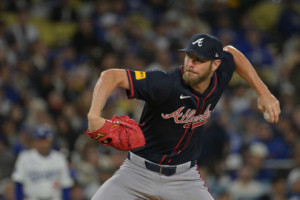
As I was standing there at 6:55, however, I saw a kid walking toward me…wearing a gray shirt with a big Reebok logo across the front. In a flash of unconscious thought, I remembered drawing that same logo on my toys as a kid. I thought about how funny it was that I had convinced myself that Reebok was better than Nike – how I had done so for no reason other than the fact that everyone else thought Nike was king. And then, in that same flash of unconscious thought, I realized: “That’s what I’m doing with Chris Sale tonight. Chris Sale is Nike, and I’m trying desperately to pretend like Reebok – Gray, Shields, and Carrasco – is just as good.”
Games had not yet started, and already I regretted my decision. “Should I switch to Sale?” But no, I had already told readers that I would not be using Sale (and heaven knows, that leads to a whole can of spilled frustration from readers when you use someone different than the player you recommended in your article – as if no one else has ever moved away from their initial thoughts on a slate…the thoughts they had 18 hours before games were set to begin). Plus, I loved my hitter setup on the day and did not want to mess up anything by changing things around to fit in Sale. So yes, I regretted it before games even started. I realized I was wearing Reebok all over again. But I left things in place.
Of course, you can guess how that went. I still nearly cashed in double-ups on the night, because my hitter selections were great…but I was an immediate 42 points behind the field because Sale was over 70% owned, and that was the amount by which he outscored Sonny Gray.
That sucked.
But really, it wasn’t all that bad. Because here’s what I realized: I need to stop wearing Reebok in Daily Fantasy Sports.
I know that I talk a lot more than most DFS writers about “missteps I’ve made” and “things I need to correct.” I don’t know – maybe that’s not the best approach. Maybe that’s off-putting to some of you – maybe that leads you to think, “I don’t want to listen to this guy. He seems to always be talking about mistakes.”
But here’s my thinking: What good does it do you if I always talk about my triumphs? A couple weeks back, I cashed in the Gold Glove on DraftKings (the $1060 tournament) eight times in 14 tries, including four top-3 finishes. The following week, I cashed in double-ups seven days in a row. Does it benefit your bankroll and your DFS skills for me to go into detail about those positive runs? My thinking: No. At least, it would not benefit you as much as it would benefit you for me to talk about the valleys I go through – and the lessons I learn along the way – that help me reach a point where lengthy, positive runs are possible.
You see, it is not during good runs that I learn the most about how to succeed in daily fantasy sports. It is, instead, during bad runs when I learn the most – during those times when I have to figure out what I am doing wrong, and what I can do differently to turn things around. It is during these times that I am able to identify mistakes of mine that lead to poor performance, and when I am able to learn from these mistakes and avoid these mistakes in the future. It is these runs – and these learning experiences – that lead to my good runs always growing longer, and my bad runs always shrinking. And it is these learning experiences, I feel, that will ultimately benefit readers the most.
Hopefully, you read things like this and identify with them on some level. Hopefully, you were able to read this intro and think, “You know what? I do the same thing sometimes. I need to stop that as well.” Hopefully, the next time you are considering wearing DFS Reebok, you will realize what you are doing, and will change shoes before your bankroll pays the price. Hopefully, you can learn from my mistakes as I make them, instead of having to make – and learn from – the same mistakes yourself.
Hopefully your good runs continue to grow longer, and your bad runs continue to shrink.
Hopefully you stop wearing DFS Reebok. I know I plan to do just that myself.
Now, there were some discussions in the comments last week about my intros, and about them tying into (or not tying into) the rest of the article. My advice: I generally label the start of the DFS-specific stuff in a pretty obvious manner. I also generally try to make the intro something that will genuinely help you in your DFS journey, of course – but feel absolutely free to jump down to the DFS-specific stuff each week. No hurt feelings from me.
With that, let’s move onto the DFS-specific stuff I have for you this week.
In talking about Nike and Reebok, I started realizing that we sometimes may be confused as to who the “Nike” pitchers are and who the “Reebok” pitchers are. Because you may not be keeping up with the peripherals of each pitcher as the season progresses (especially younger pitchers who may have worse career numbers than they are putting up this year, but who have started to develop into something special), I want to take a moment to explore some of the pitchers whom you may not currently realize can be listed under the “Nike” heading, along with some of the pitchers you may not realize might be considered “Reebok” at the moment.
You ready?
Let’s go.
NIKE PITCHERS: JUST USE THEM!
The “just use them” part of that headline is not entirely true, as there are caveats to all pitchers, but I thought it was clever since that references the Nike slogan (wait, what? – it wasn’t clever? – crap…). These are, however, the pitchers I feel should be given more consideration than they are typically given at their respective prices, and/or are the pitchers I feel many people may not realize should be labeled as “Nike” right about now.
Chris Archer: Chris Archer has the third best K% and the third best SIERA in all of Major League Baseball (actually…I am writing this on Saturday night, before Max Scherzer stats from his no-hitter have been added to Fangraphs; considering he is inches behind Archer in both categories, I’ll go ahead and assume Archer is now 4th in each). The only pitchers above him in each category are Chris Sale and Clayton Kershaw (and, of course, probably Scherzer). Yes, he has had more clunkers than those guys. But he’s also an extremely young pitcher who is still developing. He is priced high, sure…but when you look at his price – and his matchup – on any given slate, ask yourself if you would use Sale, Kershaw, or Scherzer at that price, in that matchup. If the answer is “Yes,” you better darn well use Archer!
Francisco Liriano: I’m sorry. I really am. I’m sorry to you, and I’m sorry to me. For months, I’ve been telling you in my articles why I never use Francisco Liriano (the walks are too high! – the implosion risk is too big!). But while it’s tough to believe a guy can change/grow so much in his age 31 season, he currently has the best K% of his career, along with his best BB% in five years. On top of that, he has the best SIERA he has had since 2006 – his first full season in the Majors. I don’t dislike Liriano – I just see him more as a “great value play in the right matchup, at the right price.” Because his price has risen with his performance, however, I’ve generally stayed away (I think I’ve used him once all season). But currently, he has the fifth best K% in the Majors, and he has the seventh best SIERA in the Majors. Yeah. As long as the matchup is halfway fine, he’s very much worth the price.
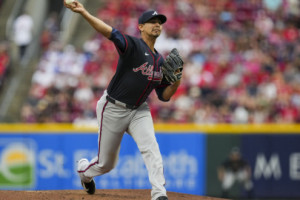
Indians’ top 3: News flash: Corey Kluber, Danny Salazar, and Carlos Carrasco are all awesome. These three are all in the top 10 in the Majors in SIERA, and they are all in the top 11 in K%. This is a big one, because all three guys have had some clunkers lately, which is lowering their prices, and is lowering their perceived value. According to the numbers, however, all three have gotten very unlucky this season for the most part…and this means we have a chance to get a Top 10 pitcher at a reduced price every time one of these three takes the mound. Unless one of them is in a particularly difficult matchup, continue rostering them, and trust that the numbers will come around the way that they are supposed to.
Jason Hammel: Can you guess who is 15th in the Majors in K% – right between Matt Harvey and Jacob deGrom? That’s right – it’s Jason Hammel. Can you guess who is 14th in SIERA, right between Matt Harvey and Jacob deGrom (and a few ticks ahead of Felix Hernandez, James Shields, Johnny Cueto, Cole Hamels, Zack Greinke, Madison Bumgarner, and Sonny Gray)? Yup. Hammel again. Generally speaking, he is priced lower than all the other guys I just listed…and he is valued lower by most in the DFS community than all the other guys I just listed. When you have a chance to roster Hammel at wherever he is priced, consider where his peripherals stand in relation to those other names…and ask yourself whether you would roster those guys in Hammel’s matchup, at Hammel’s price.
Andrew Cashner …at home: At home, Cashner has a 29.3% strikeout rate and a 2.49 xFIP. If those were his stats for the season as a whole, he would have the seventh best K% in baseball and the fourth best xFIP in baseball. When Cashner pitches at home, think of him as Nike.
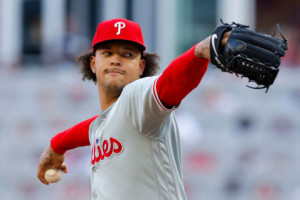
Taijuan Walker …at home: At home, Walker has a 28% strikeout rate and a 3.37 xFIP. While the xFIP is not elite (that would have him in about the top 20% of qualified pitchers if that were his xFIP for the season), Walker is not priced as an elite guy. And that K% would put him eighth in the Majors if it were his K% on the year, instead of just at home. As with Cashner, you should give Walker a significant upgrade when he’s pitching at home – which is important to understand, as his price is based off his overall performance, which makes him significantly undervalued when he pitches at home.
Ubaldo Jimenez …at home: This year, at Camden Yards, Jimenez has a 25.3% K rate (would be top 20 amongst qualified starters), and he has a 2.58 xFIP (would be sixth among qualified starters). “But Ubaldo has such a problem with walks!” At home this year, his BB% is a minuscule 4.4% (that would be the 11th best mark in Major League Baseball). He’s changed his approach to pitching this year, using his two seam fastball far more than ever before, and throwing his splitter far more effectively. This has translated to increased success overall, but these results have been particularly notable at home. When Ubaldo is pitching at home in a non-difficult matchup, I love using him on my rosters.
Rubby de la Rosa …at home: The fact that Chase Field is not the best park for pitchers has not bothered de la Rosa much, as he has turned in a K% of 24.5% at home this year, and has turned in an xFIP of 3.05. Like the other “at home” guys listed, de la Rosa’s DFS price is based on his overall numbers (including the handful of very poor outings he has had), which means he is typically a tremendous value when pitching at home.
Chad Bettis …against righties: Against righties this year, Bettis has allowed a .309 wOBA (which is not elite, but is very good considering Coors Field is his home ballpark), and he has notched a 2.99 xFIP with a very strong 24.7% strikeout rate. He has induced ground balls at a high 50.9% rate to righties, and he has only walked them at a 6.5% clip. I like Bettis against righties so much that I nearly used him against the Brewers on Saturday, at Coors Field, as the Brewers strength is their righty bats (the only reason I did not use him was because I had just come off my Chris Sale “Reebok” day, and Carlos Rodon was priced practically the same as Bettis). My point is: If Bettis is facing a team that is almost all right-handed bats (or a team whose strength is its right-handed bats,with lefties who are generally not scary at all), give him strong consideration at his consistently low price.
REEBOK PITCHERS: REEBOK HAS A SLOGAN?
In the same way that the “Nike pitchers” are the guys I feel deserve more consideration for the places at which they are priced, and/or are the pitchers who are better than many people realize at the moment, these are pitchers I feel are given too much consideration for where they are priced, and/or are the pitchers who are not as good as people seem to generally imagine. These are, of course, the types of guys I would try to talk myself off of Chris Sale or Max Scherzer to use…when that would almost always be the wrong move to make.
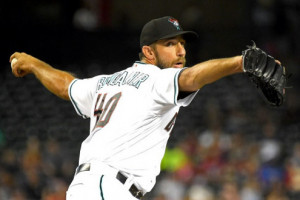
Madison Bumgarner, Sonny Gray, and Zack Greinke: I’m going to get the three most controversial guys out of the way first. And listen: I’m just telling you what the numbers say. Okay? I know you probably love using these three guys every time they pitch (at least, that’s the case if you are like 70% of the people who play MLB DFS), but all three guys are outside the top 25 in K%, and all three guys are outside the top 20 in SIERA. Are they good pitchers? Yes – they are all very good pitchers. But have they been pitching as well as where they are typically priced? No. Have they been pitching as well as what their ownership would typically indicate, even in not-great matchups? Not at all. The reason this is a controversial one is because the DFS points are usually there (at least…they’re usually there for Greinke and Gray, with Bumgarner tending to be a bit more hit or miss). But if you want to trust the numbers (and for the most part, that’s what you should do), these guys all have basically the exact same K% and SIERA as one another. There is a fourth guy bunched up with them in these two stats: Clay Buchholz. Do you use Buchholz regardless of matchup? No, of course you don’t. And yet, these guys are priced far higher than Buch, and they are always more highly owned as well – regardless of matchup. Over the course of the season, the way they are actually pitching – according to the peripherals – will start to bear itself out in their counting stats more and more, and those who are willing to fade them outside of great matchups (the sort of matchup in which you would use any other Top 20/25 pitcher) will reap the rewards when the good times come to an end.
David Price: I almost hate to write up Price, as he has been pitching so well lately. There is also the big benefit, with Price, that he’s often allowed to throw over 110 pitches (which basically buys you an extra inning each game – and probably an extra strikeout each game; on top of that, he’s generally economical with his pitches, so numbers that would lead to 6 or 7 innings for most guys can often lead to 8 or 9 innings for Price – which nearly buys you a couple extra innings and an extra K or two – all things that need to be factored in when considering which pitchers you want to roster). With that said, it needs to be pointed out: Price is 32nd in the Majors in K% and 35th in the Majors in SIERA (out of 107 qualified starters; in other words, not really all that good). Considering he is priced as an uber elite pitcher, you need to be aware of those numbers. Yes, he’s been pitching better lately. Yes, he goes deep into games. But realize that he has been a Top 35 pitcher this year, not a Top 10 pitcher as his price and ownership might lead you to believe.
Jake Odorizzi: Odorizzi still seems to be viewed as a strikeout artist. His 20.5% K rate on the season says differently. Just something to think about when he comes off the D.L.
Garrett Richards: Richards has been pitching better lately, but his price, his ownership, and the general public perception of him all seem to be ignoring the following facts: He is in the bottom half of the Majors in K%…and he is in the bottom third of the Majors in SIERA. I’m keeping a close eye on Richards, as there is every chance he will continue improving and regaining form as he moves farther away from his gruesome knee injury. But for now, he’s still a “wait and see” guy for me.
Jordan Zimmermann: Hopefully no one, at present, is considering Zimmermann to be an elite DFS option, but just in case you are constantly thinking, “Wow, I can roster Zimmermann at a huge discount,” realize this: he is in the bottom third of all qualified pitchers in both K% and SIERA. Still think it’s a great deal to be able to roster him cheaply?
Shelby Miller: Miller’s 4.08 SIERA puts him in the bottom half of the league, just behind the likes of Colby Lewis and Jeff Locke. His 18% strikeout rate puts him in the bottom third of the league, just behind the likes of Dan Haren and Joe Kelly (oh – and Colby Lewis and Jeff Locke). Obviously, Miller has found a way to outperform his peripherals…but as his price has continued to climb throughout the season, I have continued to stay away. And I will continue to do exactly that.
Nothing against Reebok, of course. But is that really the logo you want to be drawing on the boots of your G.I. Joes? Is that really the shoe you want to be stuck trying to convince others is better than Nike?
Do you really want to find ways to convince yourself the non-elite plays are the best plays available? Or would you rather stick with the best?
Make sure you are continuing to follow the peripheral stats and the developments of various pitchers to know exactly whom you should view as Nike and whom you should view as Reebok…and then, leave those honeycomb-bottomed shoes to the suckers, and strap on your Nike Airs for DFS triumph.