
10 Definitely Interesting, Possibly Helpful MLB Notes for Friday, March 30th

Welcome to 10 Definitely Interesting, Possibly Helpful Notes! In this column, I’ll work to uncover some interesting bits of information that might shed some light on players from that day’s slate of MLB games. This is not a picks column, nor is it a “fun facts” article – it’s something in between.
I hope you enjoy it, and I hope it helps you think about today’s MLB plays in a new way as you build your DFS lineups. Here are 10 MLB notes for Friday, March 30th.
Friday, March 30th
1. Since 2010, David Price is one of just three pitchers in MLB to record six season of a sub-1.00 HR/9 in at least 186 innings pitched; the others are Jon Lester and Clayton Kershaw. Price, long known as one of the more consistent high-end pitchers in baseball largely because of his ability to suppress the long ball, dealt with injuries that limited him to 74 2/3 innings pitched in 2017. But he looks ready to go this year, and against a light-hitting Rays team in a friendly pitching environment, Price should follow Chris Sale’s Opening Day gem (6 IP, 0 ER, 9 K) with another strong outing. He’s firmly in play for cash games and tournaments.
2. On the other side of the same game, Blake Snell is beginning to display some of the same love for pitching at Tropicana Field that Chris Archer is known for: of the 11 games in his career that he’s reached seven or more strikeouts, nine of them have come at home. For his career, he’s posted a 25.6% career K rate at the Trop, compared to a more pedestrian 20.1% elsewhere. But it’s not just the strikeouts. At home, he’s got a career 3.20 ERA; on the road, that number rises to 4.54, a number which is supported by his FIP (3.59 home, 4.18 away). It’s probably too early to say Snell is definitely better at home, but he needs any advantage he can get against a dangerous Red Sox lineup on Friday. Snell is strictly a tournament play, but his increased control over the second half of his 2017 season (when he nearly cut his walk rate in half, from 14.8% to 8.0%) coupled with his strikeout stuff makes him an interesting option for tournaments.
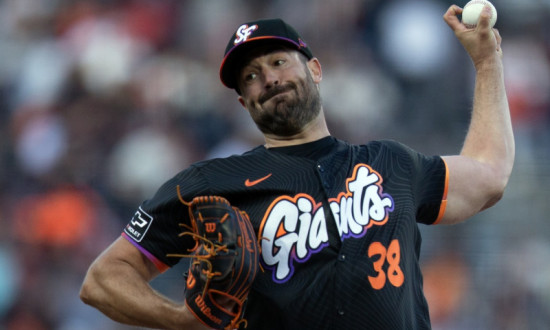
3. Let’s take a look at the evolution of an elite strikeout pitcher by examining Robbie Ray’s outside-the-zone contact rates by season since his debut in 2014:
2014: 78.3% (small sample of 28 2/3 IP)
2015: 69.1% (127 2/3 IP)
2016: 58.5% (174 1/3 IP)
2017: 46.1% (162 IP)
And it’s necessary for Ray to generate whiffs on pitches outside the zone because – I don’t know if you’ve heard – Ray had the highest hard-hit rate in MLB last year among qualifiers at 40.4%. But here’s the deal: Chase Field could very likely become a pitcher’s park this year, and Ray’s hard hit issues could be nullified, at least to some extent. If he can continue to get hitters to chase, preserving his pristine, ever-so-close-to-thirty-percent strikeout rate from a year ago, this is a pitcher we’ll be using all year in DFS. The Rockies have some thump in their lineup – Arenado, Story, LeMahieu, and Blackmon all had wRC+ marks above 133 against lefties last year – but as we saw with Noah Syndergaard on Opening Day, high-strikeout pitchers can absorb a few earned runs. As a -160 favorite and priced at just $8,700 at DraftKings, Ray is a bargain and is cash game viable.
4. Only one pitcher had a 29.0% strikeout rate and a 49.0% ground ball rate over the second half of 2017: Masahiro Tanaka. The problem is, of course, that when Tanaka does allow hitters to elevate, they tend to do damage: his 21.2% HR/FB rate was highest among the 58 pitchers who qualified for the ERA title last year. As long as his homer problems are there (he had 10 multi-homer games last year) he’ll remain a tough name to click for cash games, as things can sour in a hurry. Luckily, he limits the free passes and has ranked in the top eight in walk rate in all four of his seasons in the big leagues. Experienced DFS players will recall Tanaka’s Opening Day implosion from a year ago (seven earned runs before exiting in the third inning), but that was an outlier from the usually reliable Tanaka. He’s an excellent tournament play against a righty-heavy Jays lineup.
5. Aaron Sanchez has missed a ton of time with injury, but it’s worth noting: this is a pitcher who has been absolutely elite against right-handed batters since his debut in 2014. He ranks first with a 0.4 HR/9 over that span. His .255 wOBA allowed ranks sixth-lowest in MLB among starters (min. 186 IP), trailing only Scherzer, Kershaw, Hill, Kluber, and Arrieta. His 24.3% hard hit rate ranks third-best behind only Roark and Arrieta. He ranks second with a 60.3% ground ball rate, trailing only Dallas Keuchel. So, while Giancarlo Stanton, Aaron Judge, and Gary Sanchez all have the ability to homer in any matchup, it’s tough to bank on it against a pitcher with this sort of track record against right-handed batters.

6. Kris Bryant has, in a span of just a few years (and just a few hundred plate appearances) drastically improved his approach against left-handed pitching. Check out how his strikeout rate has plummeted over his career when he’s had the platoon advantage:
2015 – 36.6%
2016 – 19.4%
2017 – 15.3%
Against a combination of unproven lefty Caleb Smith and an awful bullpen (ranked 28th by Travis Sawchik in FanGraphs Positional Power Rankings, Bryant is a building block to center your lineups around on Friday.
7. Last year, Justin Upton was the only player in MLB with a .472 wOBA and 43.8% hard hit rate against lefties. In fact, no player matched those numbers in 2016 or 2015 either. There’s a decent chance this is just small sample size noise, as Upton had not shown a strong preference for lefties prior to 2017. However, Upton is in a favorable matchup against Oakland’s Sean Manaea on Friday, and he may come in at relatively low ownership given he’s not typically considered a part of the “lefty masher” club populated by guys like Nolan Arenado, Josh Donaldson, Nelson Cruz, or Adam Rosales (okay – that last one was a joke to see if Derek Carty reads my article).
8. In 501 career plate appearances at home against lefties, Paul Goldschmidt has a 186 wRC+. That’s just a few points off the career wRC+ of Ted Williams (188). Obviously, Goldschmidt’s past numbers at home will become less relevant as we understand the true impact of the humidor, but even assuming Goldschmidt’s numbers take a hit, this is still one of the best hitters in the game, and against Tyler Anderson and his hefty .358 wOBA against righties in 2017, Goldschmidt is a top play at the first base position. Monitor Goldschmidt’s home ownership moving forward, because if DFS players overrate the humidor, it could lead to suppressed ownership and a buying opportunity, as “Goldschmidt at home versus a lefty” was once considered an autoplay.
9. Doug Fister’s hard-hit rate since 2016 against right-handed batters: 24.6%
Doug Fister’s hard-hit rate since 2016 against left-handed batters: 38.1%
In case you aren’t good with numbers, that is a big difference, and it’s cause for DFS players to temper our expectations with Astros righties today (similar to the Yankees righties facing Aaron Sanchez). Fister’s struggles with hard contact against lefties has led to a massive platoon split as of late: since 2016, he’s held righties to a .264 wOBA while allowing a massive .389 wOBA to lefty swingers. This platoon split leads to guys like Brian McCann, Marwin Gonzalez (switch-hitter, but he’s stronger from the left side), and …
10. Josh Reddick, who happens to be one of three players since 2015 with a sub-12.0% strikeout rate and a 132 wRC+ or better. The other guys on the list are pretty good: Jose Altuve and Daniel Murphy. The days of dreaming on Reddick’s power upside are over – he hasn’t eclipsed a .200 ISO since 2012 – but his contact skills alone make him a convenient salary saver against low-strikeout righties like Fister (15.3% K rate since 2016).
__________________________________________________________________________________________________________________________________
Thanks for reading! Stats from this article were pulled from RotoGrinders’ Daily Research Console, FanGraphs, Baseball Savant, Brooks Baseball, Baseball Prospectus, and Baseball Reference.
Check back for more “10 Notes” MLB articles every Monday, Wednesday, and Friday throughout the year, and feel free to drop a comment below if you want to leave any feedback or keep the discussion going!